Social issues like addressing inequality go with the architecture field like (insert comparison). I myself am not immune to draw of these issues as well. They carry with them a sort of holy grail of problem solving for the problem is so great and at times seems like most efforts are similar to a two steps forward one step back approach.
Total giving to charitable organizations was $373.25 billion in 2015 (www.charitynavigator.org). This is statistic can make one feel warm inside because it is evidence of humanities willingness to give. But at the same cause concern since poverty and inequality is on an upward trend as seen below on a chart put out by PEW research institute. Even though the percentage of population considered poor the amount of people considered to be how low income(less than $2 a day) has grown.
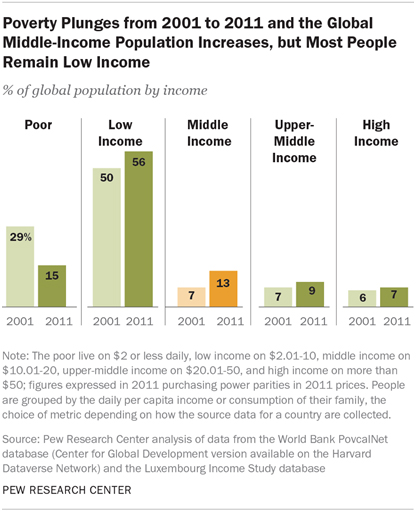
For me, looking at this chart brings to light a bigger issue. Anybody can see that no matter what combination of statics the numbers will add up to 100. What is not very clear in info graphics like these is the very realistic scenario of finite resources. this means that the best case to hope for would be perfectly even distribution. In here lay the problem, as one can see in the text below the graphic that the numbers attached to those categories represent an exponential curve.
So getting back to issue of inequality and how architecture through NPO’s address it. It is not a bad thing to want spread American prosperity to the world. I mean I am not saying that “we” the good ole USA deserve iphones and caramel lattes and no one else. Quite the opposite, for instant who even decides if anybody deserves these luxuries, or whether or not another culture believes these “luxuries” improve quality of life. In a way its almost ignorant to assume they attach happiness to materials like we do.
Sitting down to write about this has brought up three paradoxes for me. The first being that even though I am truly grateful for being born into the circumstances I sometimes question how much happiness or quality of life comes from these “Luxuries”. Don’t get me wrong I love my iPhone, but i have to question if the time spent checking reddit and Instagram is worth the time im not spending with my wife or family. The second paradox is that I know that in solving inequality is not as simple as giving people iphones and internet. In order for me to even afford a cheap iphone some body in a less that fortunate situation has to make that Iphone for far less than i would be willing to do it. Its the sad truth that part of success is built of the misfortune of others. The third paradox is the possible ideology behind charity. Take for example the business model of Tom’s shoes. 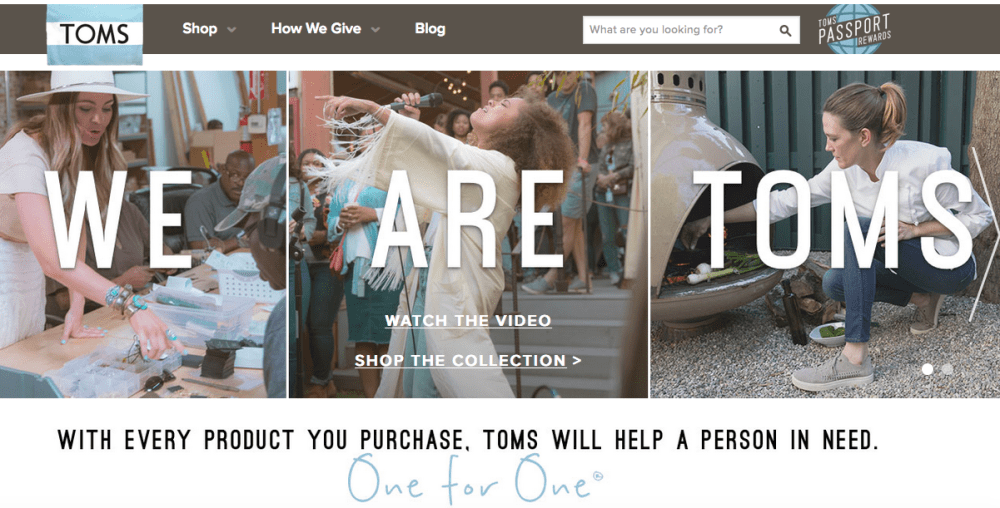
I do feel that the idea behind Tom’s is genuinely good. It is hard to argue against giving shoes to people in need. However a problem arises when looking at the slogan. “With every product your purchase. Tom’s will help a person in need”. This slogan in a way is oxymoron because in order to give a pair of shoes to someone in need the shoe has to be made by a person in a third world country for a wage that would insult most. Even with this I know that there is some good in providing jobs and a new possibility for employment for these people. But…. I also can not help but seem the real transaction taking place and that is guilt relief for material possession. This is a particularly complex issue, for I am not claiming to be against a business that is prosperous and also does some good and in a way convinces people to be charitable more often. I am however just pointing out what may be the true motivation behind most charitable actions and that is a way relieve guilt for other wise excessive behavior. It allows one to thwart healthy self reflection on whether I need another pair of shoes, or the true value of that 5 dollar latte.
What does this all mean? Well if i truly am passionate about addressing issues like inequality I have to question what am I willing to give up?
 againstindifference.com
The challenge in the West is that in most cases we are actually ruled by our bills and possessions. For example, I have to get a job that I don’t necessarily want to pay for my possessions that I purchased on credit. So the situation dictates that I can’t pay myself first if I want to maintain my “purchasing power.” And our culture perpetuates this problem because it’s the requirement to sustain capitalism.
LikeLike