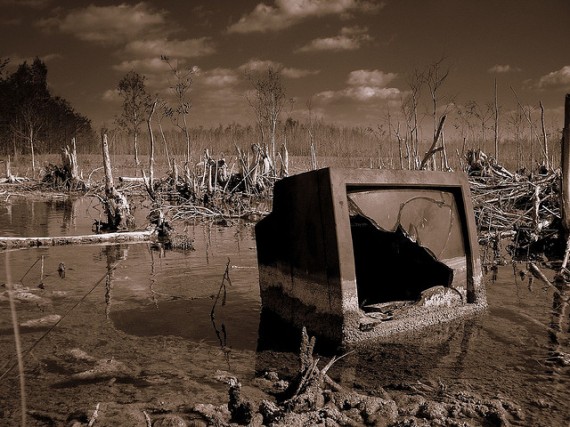
The above title is a quote from author and philosopher Slavo Zizek. I first stumbled across him and this quote in a documentary about philosophy called This Examined Life. The movie is broken into about 5-6 chapters with each one focusing on a different present day philosopher. Each section’s focus is completely up to the individual as far as the topic and location of the “interview”. Zizek’s interview took place in a land fill and he spent most of his time describing how the new ideology of ecology may not actually solve the great environmental problems that we face.
I found this view point to quite provocative as it challenged my ideas about environmentalism and sustainability as it relates to fields like architecture. Especially with two specific points Zizek made. The first point Zizek made that i found interesting is that our current approach to sustainability Idealization of nature. He claims that by we have reached a point were we have compleetly remove nature from humans and the environment we have built. In a way it allows of to separate not only our destructive behavior but ourselves from nature. By doing this we reinforce this idea of nature as a always balanced peaceful element. It allows us to compartmentalize our destructive behavior or nature’s for that matter. Doing this allows us to separate and remove the ugly realities of our consumption. We take things like trash dumps and industry that is not pleasing to this image and remove it from sight. Therefore becoming more aout keeping up this idealized image of nature. This I feel leads to pseudo solutions that promote imagery over tangible action. If we were to embrace the fact that we are always in nature and that what we do and where we live is the nature that we have built including the ugly aspects. We may force a little more self reflection that will make us care a little more about actions taken and waste or trash. Hell we may even find some beauty in it.
The second point I gravitated to way that we has humans have an ability to disavow serious issues. I believe currently we are experiencing this on two levels. The first being that both sides seem to have come to an agreement on the fact that there is some level of climate change, but there is still a debate on whether or not what is responsible for that. Well if you align yourself with the side that believes it is 100 percent part of naturally occurring cycle you have and in a way relinquished responsibility for the serious implications of this change. This can position often times is even taken in the face of overwhelming evidence of real catastrophic effects. For me this is a method of denial, for it places the cause or meaning to something outside or above us humans. Whether or not you believe this is purely natural or part of a higher powers plan. They are basically taking the role of neutral observer.
The other side of the climate change suffers from the same disavowment. For we see the evidence of our impact and still address it in a way that does not negatively impact our standard of living. I do not want to what i am saying to be confused with a negative technology stance, because that is certainly not my stance. However I feel that peoples reliance on technology advance seem to lean more toward areas focused almost soley on efficiency of existing products and production methods. As apposed to a combination of issues pertaining to cultural problems that have lead us to where we are. Of course any progress towards efficiency is generally a positive, but in most instances this progress comes in the form of indulgences. An example of this is smart windows or even electric cars. Dont get me wrong I love tesla as much as the next guy, but electric cars do not address real issues within car culture or sub urban sprawl which facilitated it. It merely allows a person to participate in the same habits as before with a little less guilt. So even if we know that there is a real problem we don’t do anything about it. The end product being a return to apathy.
This is where my field of study comes into play. Technologies like solar panels and geothermal systems have all seen great advances withing recent years. It was not until recent advance in production and cost reduction that they became commercial viable and therefore have sen an increase in use. The use of these technologies where always pushed by fields like architecture and design because generally the values embed in these fields promote sustainability. These values however sometimes clash with those of other fields that work along side architecture. So great effort has been put into framing arguments that would be convincing of even the most critical opponents that did not quite see the value in sustainable design. I even remember taking classes in Graduate school dealing with this very issue. Thankfully we are now seeing the tide turn as these technologies has lowered their cost to were they are being used more and more. I feel that even with this victory it somehow doesn’t solve the issue or may even highlight a bigger one. For me the fact that these technologies were only embraced when there object cost was low enough to justify in a way highlighted our collective enabilty to see or quantify there true value. This value was slightly subjective because sustainability causes and climate change issues deal with the collective well being and are not factored into a developers bottom line. So i feel in a way that the well meaning nature of these sustainable technologies has somehow been co-opted. What I mean by this is that even though we may have been successful in getting more green sustainable strategies into a project it comes at the cost of conforming to the value sets of others. Minds have not been changed nor values or goals. Even with this success we are only successful in lowering the cost of a product. This does not mean that a developer has began to look at projects differently or that they will now embrace values that drive an architects design decisions.
My views maybe a little cynical but i feel that by conforming to these value sets and justifications we place importance on bottom line cost. This is were apathy and indifference take foot because we live in a system that generally only quantifies monetary cost. I feel that as a collective we have subsidized the true cost of things like unsustainable built environment and unsustainable methods of living. By falling into the same system we remove the negative effect and therefor lack care. We stay indifferent.
 againstindifference.com