In September of 2017 i packed everything up and moved to the big ole state of Texas to the Dallas fort worth area for employment. After a lot of looking I found a place to live pretty close to my work which is located in the historic neighborhood of fairmount. That will always be of high priority for me. Previously me and my wife lived in new orleans in the historic bywater neighborhood. Which happened to be right past the french quarter and only two miles from work. It just so happens that i live 2 miles from my work here in texas as well. How ever the the morning trips could not be more different from each other. Even though fort worth is a larger city then new orleans and i live within similar proximity to the downtown area the morning commutes pale in comparison.
The amount of architectural richness within my 8 minute drive to work in new Orleans is something that does not exist in Texas. I think the same amount of architectural density is stretched out over 35 plus miles from Fort worth to Dallas. Which means its basically nonexistent. In comparison one feels alienated from experience that is fundamental to being… well human.
The urban environment( or lack thereof) is not the only difference. With the move to a big new city came more opportunity and bigger roads and bigger investments in infrastructure and urban project. There is daily talks on the news and with people about potential projects to benefit this area like ikea’s and possible amazon headquaters. Or Hyper-loops connecting both cities along with austin and houston. It is like the future is here, happening now.
The hyper loop talk is one thing that I peeked my interest when first hearing about it. The thought of traveling to austin in 19 minutes as opposed to the hours it takes by car seemed like a great solution. Until i started to think more about what exactly was it a solution to. The hyper loop addresses the disconnect of cities spread out to much and to far from each other. So it addresses a symptom of a problem that we created by a lack of urban density therefore created disconnection. We are solving the problem of disconnection by some technology that will only perpetuate it. This is madness
The city of New Orleans covers around 349 square miles while fort worth covers around the same at 350 square miles. Of that area, New orleans only has around 168 square miles of occupy able land while fort worth has some where around 340 square miles of occupy able land. The population density of both cities is in between 2,000-3,000 people per square mile. Which can be a little misleading since less than half of New Orleans is actually able to have people live on it. This translates to around double the population on half of the physical land. Possibly Explaining the rich experiential urban fabric as people build a rich dense urban environment.
There was never any talk of hyper loops in New Orleans, one reason was they could never afford it, the other was there was no need for it.
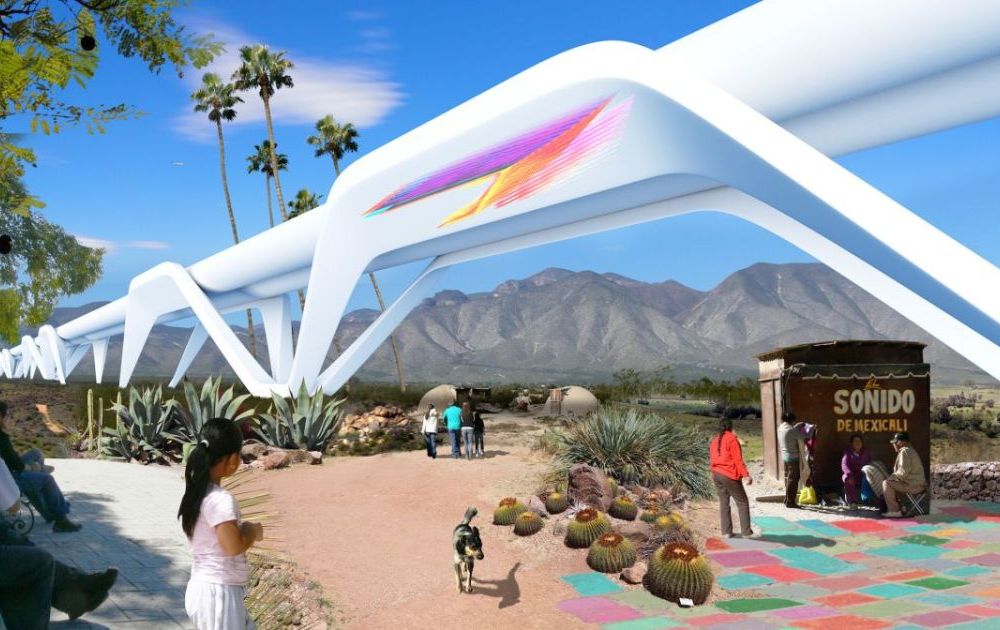
The rendering at the top of this post shows an “idealistic” vision of what a hyper loop could look like and tries to paint a picture of the positive impact it could make. It does everything right it has people to add a human scale to it is has a nice picturesque background, it even has animals. How ever all I see is vast expanse( desert) that in reality would be void of any human activity hence the need for a hyper loop in order to connect the fragmented severely malnourished urban environment. In fact there is not much that could possibly be more alien and foreign to the human experience than traveling in a dark tube at hundreds of miles an hour. This used to be the preferred method of transit for bank deposit before we began to go paperless. I do not know about you but I am not a piece of paper, I want to see things I want to touch and feel the texture of the environment. I want experience.
I feel It is easy to get caught up in new technology and the excitement of companies like Tesla that I believe genuinely have intentions to solve problems. It can be especially in a field like architecture as well since we have always pushed for solution and progress as something that will ultimately fix the mess that we find our selves in. With finite resources being depleted and fractured nonexistent urban environments. One thing we seem to assume is that progress is linear, it however is not. this is due to our limits with language and the almost identical meanings we have applied to words like progress and forward. They have come to mean the same thing.
So I feel professions that deal with architecture, urban planning and future professionals in school have to become more analytical of the solutions we offer through our proposals and projects. We are in a wonderfully optimistic field that accesses the problems of the built environment that involve the building sciences along with the social and economic sciences. We propose not only solutions but idealistic predictions of how we not only see the world but how we feel it should be. This requires a certain ability to remove one self from the issue in order to have a unbiased (as possible) take on the issue and form questions that drive solutions. In some cases the question may be more crucial than a solution itself. In fact after all my education in architecture school the most valuable skill i was learned was the ability to ask the right questions. It far outweighed any computer software I learned or any courses on construction or design.
So why do we need a hyper loop? Why are our cities so disconnected? Why do I need to travel to austin in 19 minutes? Why does the city I live not have what i need which drives me to travel hundreds of miles away? Why is this better than building better cities? Why is long distance travel the solution to long distance travel?
 againstindifference.com