Resiliency is one of those words thrown around in urban design/architecture a lot when talking about sustainability and green design. These new terms used to describe design ideologies are an appropriate reaction to massive problems and threats to cities, urban infrastructure and communities/cultures. I understand how design can be applied to cities and urban planning. When it comes to communities culture, resiliency is an inherent characteristic or a defining element. Communities exist because they are resilient, they do not become resilient they are resilient itself. Culture is not a design feature.
Generally my blog post are sparked by some small issue or observation I have while reading something that finally clarifies some previous frustration on a bigger issue . I usually focus on one small thing that irritates me and I pick at it until I figure out (or believe I have figured out why it bothers me). Generally all of my issues i have are based/ rooted in architecture and design. due to what I believe is my hate for architecture that is only exceeded by my love for it.
Resilience is defined as the “intentional design of buildings, landscapes, communities, and regions in response to vulnerabilities to disaster and disruption of normal life”.
The above definition is from the Resilient Design Institute. This definition is not the source of my concerns with architectures approach to resiliency. However it illuminated something to me through the way they choose to define resilient design. This definition describes buildings, landscapes, communities, and regions as areas where design can be implemented to address resiliency. I take issue with this definition for its use of communities. The association of communities along side buildings, landscapes and regions, is a problem for me and highlights a underlying issue through out the entire field of design and architecture. Architecture in no way is responsible for the design or creation of community. Communities and furthermore culture can not be drawn on a plan it can not be sketched, it does not go through the design process. Architecture and design when it is successful can only at best hope to facilitate and cultivate an environment conducive to community.
I fully understand that this analysis or critique relies heavily on my own assumptions and bias. However as I stated previously my rants usually are triggered by something small that illuminates some ideas I’ve had previously .
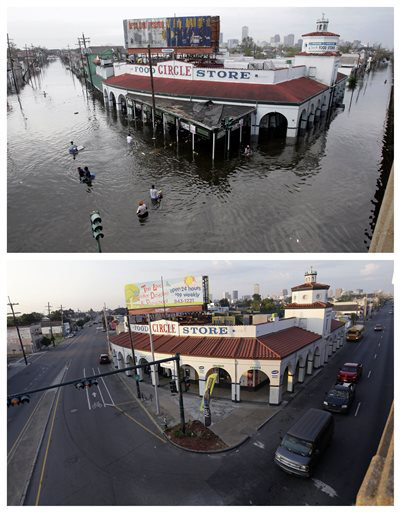
The above pictures show one location in New Orleans. I probably don’t even need to explain this or what events the above pictures contrast. The pictures show the Circle market at normal conditions and the contrasting picture shows it as it looked during the floods from Katrina or it could be from the 2017 august flood or it could be a prediction for what it may look like with future rain events, or New Orleans future in general.
Since Katrina, there have been tons of studies and projects all focused on sustainable resilient design. Every one understands the importance of New Orleans culture and community. So how do we save it? How do we safe this culture? How do we save one of the great historical cities we have? The harsh reality is we can only save when we stop destroying it. Beyond things like sea level rise and climate change we have had decades of design and built environments that have done little if anything to cultivate anything but our own appetite for growth.
In my limited time living in New Orleans from Feb 2017 to Sept 2017 I consistently found both frustration and amazement with the city. I was in awe at how such a place could exist in the face of all we have done to undermine it. When I look at the flood pictures I cant help but see what is not in the picture anymore. I can help but see what looks like a river over what would be the river bottom. This Bottom in this case is the road and or pavement. Miles and miles of impervious surface. Hundreds of thousands of square footage’s dedicated to machines not humans not bicycles not trolleys. I find this to be the elephant in the room when it comes to any discussion of resilient design or architecture for New Orleans. For the past century cities have been designed not for humans but for the transport of individuals in the name of progress and innovative urban planning. We had done more collectively to kill communities through interstates that cut through neighborhoods and 50 mph streets that kill walk ability than we have ever done to create community.
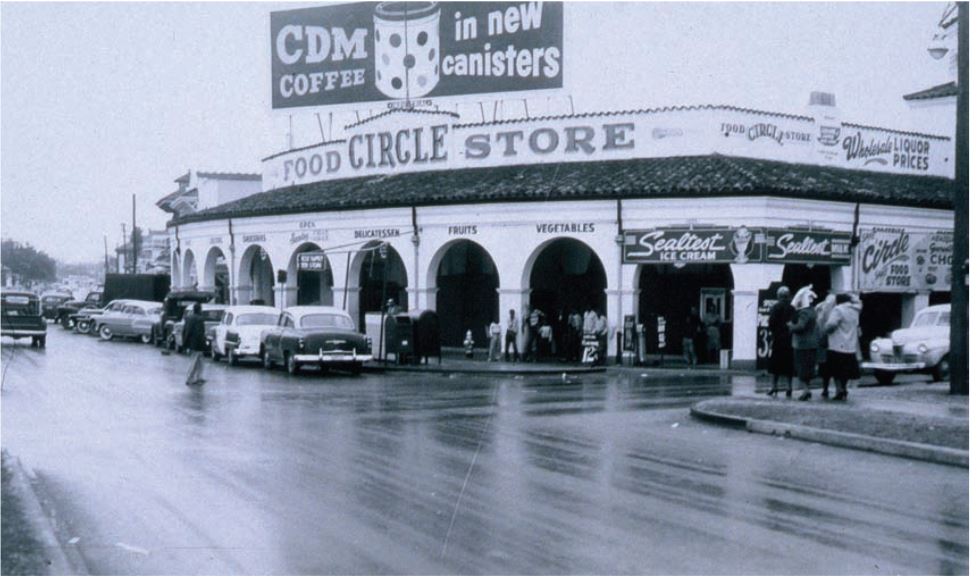
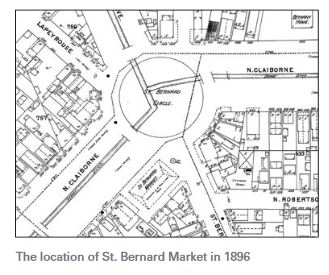
This brings me back to the pictures of the flooded store. The picture above is one of the same location from 1950 and the map below that shows the plans for a market at that location from 1896. This location as been a one of importance to the community for more than a century and the surrounding community has been there for longer than that. It is only one example of hundreds spread through out the city. This one example highlights only one spot that embodies the major issues that plague not only New Orleans but every city. The problem I speak of is design for people and communities that is clearly not designed for communities or people. I would assume propose that 50-60 100 years ago these driving forces were all pushed in the name of cutting edge innovative design and urban planning centered around the progress of people. I would argue that in the case for New Orleans past urban planning strategies are just as much responsible for its current and future problems as climate change and hurricanes. The interesting thing for me is that we can correct our previous design errors. Hurricanes we cant control , climate change is a slow moving problem that will persist for years to come even if we change our habits immediately. Mistakes architecture has made is one area that can be immediately addressed. A great deal of effort is put studies and master plans that dance around the issues but never fully embrace or admit to massive amounts damage done to cities and communities in general by urban designer/master plans put forth in the name of progression and smart growth. Much like the current master plan assembled by the city at this link
Click to access Resilient_New_Orleans_Strategy.pdf
Of course the study is a well put together document that assembles a ton of data and analysis from experts in all areas. It addresses not just sustainable design challenges but also economics and business challenges. with sections on a wide range of subjects including things like public transportation and green infrastructure. In these sections the report talks about increasing efforts and plans to implement things like more bus lines and more rain retention areas. I find the report speaks in positive terms such as additions and growth which conveys positive themes as do most optimistic views put forth for grand design visions that address issues plaguing a great city. This is of course where i feel master plans like these always fall short. They do little to covey proper historical context with little to no explanation of causation of these problems. For instance in the section about public transportation i feel it would be beneficial to note that at one point there was approximately 24 different trolley lines servicing the city, presently there are 5 lines. Another interesting fact is that the implementation of bus lines in the 60s and 70s drove the removal of these trolleys lines until there was only the Saint Charles st line left. The incorporation of bus lines did two things firstly they allowed for a more flexible public transit system and secondly they fit into a urban environment that embraced Americas car culture. In turn we get more vehicles more infrastructure in order to transport a similar amount of people in a city is limited to only 169 square miles, 1/3 of that being wetlands. So my main issue with master plans and or any greatest design ideologies like resilient design or sustainable design is that they rely on addition and never fully address past mistakes. They do not speak of undoing past missteps instead choosing to propose additions and retrofits while minimizing alterations to existing infrastructure.
Realistically no amount of rain gardens or bus lines will address the negative effects or early 20th century urban planning or climate change for that matter. Addressing the influence and impact of elements that stifle community growth and culture will. If 1/3 of New Orleans are wetlands i wonder what percentage of it is paved. I wonder what percentage of it needs to be wetlands in order to address flooding. I feel that in order for New Orleans, or any coastal city for that matter, to be truly resilient we must focus ideas on adaptation not addition. Sometimes progress comes at the cost of regression.
In light of this I am optimistic. For the community and culture have gravitated to this city and the city provides a place that has cultivated a rich and infinitely interesting over community over centuries that survives to this day. Not due to resilient strategies but because it is resilient. It is resilient in spite of resilient design.
 againstindifference.com