The fiction in meaning

Every year or so, me and my wife will have a history scholar come and stay with us for a month or two.  When they come to visit from their home in Venezuela. I have the opportunity to have an additional person to have interesting conversation with.  Often times these  conversations leave me barely treading water for not only am I having a conversation with a former university professor,  but also a person who worked in historical preservation of architecture.  So they are well versed in multiple subjects with a deep philosophical understanding as well.  Ive been accused of being a grumpy cat so I happen to really enjoy challenging discussion about history and architecture’s sociological implications.  The more challenging provocative/cynical the better for me.

Often times conversations between would start on a seemingly simple mundane topic.  As we would progress the conversation would eventually get to a point were I was either deeply questioning some thoughts or opinions I have withing myself or the topics allowed my to stumble onto new thoughts.  Sometimes these ideas may not fully manifest until later.  Much like these thoughts I am typing about right now are based on a conversation from almost a year ago.

It was during the spring of 2016 towards the end of my 2nd semester as a graduate student.  I was deep in the middle of course that prepared us for my coming thesis project.  So I was trying to find out what my ideals about architecture were, and I was trying to decipher or translate my frustrations with it.  I felt there was a severe disconnect between architects/designers and “architecture”. From my perspective there is a real detachment, or self imposed divorce from the intrinsic nature or experience  From all the theory that we have to read to some of my professors themselves;  I picked up, what felt like to me was a deep desire to justify architecture objectively.  Almost as if Victor Hugo was both the reaction and a causation when he wrote that the printing press had killed architecture in the early 1800’s.   I mean how could one not feel threatened by a statement like that or be forced to react.  Justifiably  modernism attempted to address these insecurities by resisting ornamentation and embracing function.  This was causing me to experience a sort of existential crisis within my own little world of architecture.

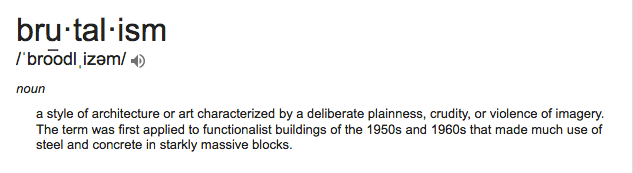
Well like I stated before the conversations between myself and the visiting professor that day began with discussion about the futurist architecture movements and then onto the types of architecture in Latin America compared to the west.  Eventually we began talking about the use of concrete and its implementation.  I believe i may have made a comment/comparison to brutalism when discussing a piece of architecture or style she liked.  Well the conversation began to take on the ton of a debate as she took offense.  I did not quite understand as i kept on describing the architecture as brutalist in nature.  Eventually my wife came into the conversation.  The professor’s main language is obviously Spanish , and she understands English but only speaks a little of it, Which is more than i can say because i am still after being married for 3 years and my Spanish is muy poquito.  So it was not until my wife joined the conversation and spoke to her in Spanish that I learned that brute in Spanish has a more derogatory meaning and that they did not refer to that style of architecture as that.  She also took offense because she enjoyed this type of architecture and appreciated its historical significance.

This was the moment in the conversation were almost immediately mythoughts or notions about a subject were washed away and challenged.  Here I was having a conversation with someone about a subject that was derailed by one word.  Or more importantly the meaning.  I, like most took the meaning as universal fact.  I was knowingly talking to someone in there second language yet for about 15 minutes I did not even think about the meaning of words I was using.  For the sake of time and efficiency, I summarized a whole typology of architecture with one word.  The meaning for me being true in the face of its fiction to another.

I never really looked at words like that quite before.  Especially now that I am looking back at this conversation.  Its as if words and meaning embody contradictory characteristics.   I am both amazed at their ability to convey and confuse.  In a way I am attracted to this idea.   They both enable us while simultaneously being responsible for our inability.


P.s

The Visiting historian is my wife’s mother (my mother in law).


Questions about Questions

I have recently taken up an new habit in which i take images like the one above and take a sort of snapshot of my initial thoughts.  My knee jerk reactions are then reviewed as I take a step back.  Often times I then interrupt my wife from her writing and online discussions a she is doing for her masters degree while she works a full time job(sorry Toscana) to bounce my ideas off of her and get her opinion and reaction/critique.  I value her input greatly for not only is it an outside perspective, it is  a psychological perspective(from which her Bachelor degree is in) and from her perspective of living abroad in very similar conditions in the above picture.  This  usually gives me a pretty good exercise in perception and analysis and basically helps me with my understanding.  So in a way I am  treating this exercise as a sort of Rorschach test.

Recently I received my master’s degree from the School of architecture and Design at University of Louisiana at Lafayette.  So i spent 6 plus years immersed in Architecture studies and now I work in the field of architecture.  I still have a long ways to go until I am licensed and can even call my self an architect.  Even if and when that happens i don’t know if I will fully identify myself as an “architect”.  Not because I don’t like the term or the profession but because I feel like it is limited by the perception of what we truly and are taught in the invaluable studio environment.  The image or architect stereotype is so attached to the idea of a building or object  that I feel it undermines what we can do.  It is similar to those memes of professions what you do versus what your friends and parents think you do.

During my time spent in architecture school i gravitated to this idea that was constantly pushed that we had to discover the right questions to ask before we could propose a project/building.  This really stuck with me, this idea that what separates us, from those who studied say engineering or biology .  Is the idea of questions holding value and priority over pre established answers that really interested me.   I know that this can come off as rebellious, and i know I tend to lean towards the rebellious side.  Hell my own thesis was a rebellion against the defined values of architecture by questioning if it had value?  So in a way I felt the architecture itself was the question.  This i feel is in complete contrast to Architecture’s image now. With it typically viewed as a solution or answer.  It prefer the idea of architectural insertion as a proposal or the way in which a designer as addressed an issue through deep questions.  Maybe this means it will attempt to resolve a problem or it can be part of a bigger dialogue or question.

Now that i have laid out a little bit of context to my approach I can talk about the image above.   My first thought when I saw the image was a typical Latin American fevela/barrio and a typical residential high rise.  Something else I saw was a typical problem linked to poverty and impoverished countries and a architectural solution, a symbol of modernist architectural solutions for housing.    The solution being based off of ideals that I myself being from America and also being a student of design and architecture know well.  A building like this addresses a lot of problems that are associated with the other side of the image.   With these ideas I I began to discuss, with my wife toscana my ideas based off these reflections.  Starting with the idea or questioning of the success or perceived success of this high rise tower.  I believe this is due to my rebellious nature, but I also felt justified in my questioning.  The difference between now and my protected bubble in architecture school was that now I have access to real time feed back from a different perspective that actually experienced this scenario.  So I  have heard the stories of people being robbed all time, including my wife and her friends and the flawed structures.  I also know that living in countries outside of the U.S. sometimes means buildings like these do offer safety and security and they are viewed as a solution.  However I still pushed with our discussion because I still feel that even though I know the  building on the right is a viewed as a solution the  question still remains whether it is a correlation or a causation.

This questioning is the same approach I initially applied to the left side of the picture.  I found that i was struggling with the image of the left being so directly associated with the cause of the problem.  I personally struggled with the idea.  For I knew from stories of first hand experience that places like these do suffer from crime and are generally inhabited by people suffering from extreme poverty.  That part is obvious from the handcrafted do it yourself structures and overall organization.  But that is exactly the aspects that  sparked my curiosity and questioning.  As I looked at the two sides I could not help but be drawn to the interesting ways in which people address their problems.  They embody a textural richness and a organic component.    Along with all of this they, meaning the Latin culture in general, have a strong and unique culture and focus on family, centered around intense socializing.  People are engaged with each other like nothing I have seen over here, even though I am from the south I find the sense of community  pales in comparison.  They are also very altruistic and usually put the success of the family and siblings above all else.   The fact that places like the left side of image embody both the negative aspects of crime and poverty and the positives of rich culture and community overall challenges my ideas and perceptions.

Towards the end of our discussion I sort of realized that issues I have may stem from my own perceptions.  I found that I am associating this building on the right with the ideal version or solution for housing in countries like my own.  This for some reason does not sit well with me.  It somehow feels like a missed opportunity and possibly a mistake.  Even though we have achieve great things as a country and culture.  I do not feel that this should merely be copy and pasted abroad.  This method not only can be insensitive issues inclusive and unique to different cultures and countries but also I believe grossly irresponsible on our part.  What I mean by that is knowing what we know now about environmental issues and the massive miss use and waste of resources. We have a standard of living that may not be realistic for every one in the world to have.  In that aspect we have to admit that we cant provide every one in the world with our standard of living,  finite resources and  economics makes that clear.  But even with this I still feel optimistic. Which is an ironic trait for architects to have because it exist directly along side our cynicism that makes us always question.

Overall after looking at this image and writing about it for the better part of the day I feel that I have some clarity on my initial reactions to it.  In it I see two contrasting elements that in them selves have so much association to things like problems and solutions.  I feel that while I am cognizant to these  and understand the driving issues I cant help but feel a sense something is being missed.  That there are elements of great value within the communities and culture that we are attempting to help by solving their problems.  We are blind to them not because we choose to be but because we just don’t understand.  Within these communities lay a completely unique set of values and culture that if giving the opportunities and help though resources can yield not only solutions for them selves but possibly lead us to a better world.  This would call for possibly a more holistic approach as designers  that priorities smaller insertions through multiple areas and multiple scales expanding beyond just simply architecture or the built environment.  Its not about what can we teach but what can we learn.  It may call for less solutions and more questions.

“Ecology, the new opiate for the masses”

The above title is a quote from author and philosopher Slavo Zizek.  I first stumbled across him and this quote in a documentary about philosophy called This Examined Life. The movie is broken into about 5-6 chapters with each one focusing on a different present day philosopher.  Each section’s focus is completely up to the individual as far as the topic and location of the “interview”.  Zizek’s interview took place in a land fill and he spent most of his time describing how the new ideology of ecology may not actually solve the great environmental problems that we face.

I found this view point to quite provocative as it challenged my ideas about environmentalism and  sustainability as it relates to fields like architecture.  Especially with two specific points Zizek made. The first point Zizek made that i found interesting is that our current approach to sustainability Idealization of nature.  He claims that by we have reached a point were we have compleetly remove nature from humans and the environment we have built.  In a way it allows of to separate not only our destructive behavior but ourselves from nature.  By doing this we reinforce this idea of nature as a always balanced peaceful element.  It allows us to compartmentalize our destructive behavior or nature’s for that matter.  Doing this allows us to separate and remove the ugly realities of our consumption.  We take things like trash dumps and industry that is not pleasing to this image and remove it from sight.  Therefore becoming more aout keeping up this idealized image of nature.  This I feel leads to pseudo solutions that promote imagery over tangible action.  If we were to embrace the fact that we are always in nature and that what we do and where we live is the nature that we have built including the ugly aspects.  We may force a little more self reflection that will make us care a little more about actions taken and waste or trash.  Hell we may even find some beauty in it.

The second point I gravitated to way that we has humans have an ability to disavow serious issues.  I believe currently we are experiencing  this on two levels.  The first being that both sides seem to have come to an agreement on the fact that there is some level of climate change,  but there is still a debate on whether or not what is responsible for that.  Well if you align yourself with the side that believes it is 100 percent part of naturally occurring cycle you have and in a way relinquished responsibility for the serious implications of this change.  This can position often times is even taken in the face of overwhelming evidence of real catastrophic effects.  For me this is a method of denial, for it places the cause or meaning to something outside or above us humans.  Whether or not you believe this is purely natural or part of a higher powers plan.  They are basically taking the role of neutral  observer.

The other side of the climate change suffers from the same disavowment.  For we see the evidence of our impact and still address it in a way that does not negatively impact our standard of living.  I do not want to what i am saying to be confused with a negative technology stance, because that is certainly not my stance.  However I feel that peoples reliance on technology advance seem to lean more toward areas focused almost soley on efficiency of existing products and production methods.  As apposed to a combination of issues pertaining to cultural problems that have lead us to where we are.  Of course any progress towards efficiency is generally a positive, but in most instances this progress comes in the form of indulgences.  An example of this is smart windows or even electric cars.  Dont get me wrong I love tesla as much as the next guy, but electric cars do not address real issues within car culture or sub urban sprawl which facilitated it.  It merely allows a person to participate in the same habits as before with a little less guilt.  So even if we know that there is a real problem  we don’t do anything about it. The end product being a return to apathy.

This is where my field of study comes into play.  Technologies like solar panels and geothermal systems have all seen great advances withing recent years.  It was not until recent advance in production and cost reduction that they became commercial viable and therefore have sen an increase in use.  The use of these technologies where always pushed by fields like architecture and design because generally the values embed in these fields promote sustainability.  These values however sometimes clash with those of other fields that work along side architecture.  So great effort has been put into framing arguments that would be convincing of even the most critical opponents that did not quite see the value in sustainable design.  I even remember taking classes in Graduate school dealing with this very issue.  Thankfully we are now seeing the tide turn as these technologies has lowered their cost to were they are being used more and more.  I feel that even with this victory it somehow doesn’t solve the issue or may even highlight a bigger one.  For me the fact that these technologies were only embraced when there object cost was low enough to justify in a way highlighted our collective enabilty to see or quantify there true value.  This value was slightly subjective because sustainability causes and climate change issues deal with the collective well being and are not factored into a developers bottom line.  So i feel in a way that the well meaning nature of these sustainable technologies has somehow been co-opted.  What I mean by this is that even though we may have been successful in getting more green sustainable strategies into a project it comes at the cost of conforming to the value sets of others.  Minds have not been changed nor values or goals.  Even with this success we are only successful in lowering the cost of a product.  This does not mean that a developer has began to look at projects differently or that they will now embrace values that drive an architects design decisions.

My views maybe a little cynical but i feel that by conforming to these value sets and justifications we place importance on bottom line cost.  This is were apathy and indifference take foot because we live in a system that generally only quantifies monetary cost.  I feel that as a collective we have subsidized the true cost of things like unsustainable built environment and unsustainable methods of living.  By falling into the same system we remove the negative effect and therefor lack care.  We stay indifferent.

Inequality part II (benefits beyond guilt relief)

My previous post began to touch on the issues/paradoxes within charity.  It discusses the convoluted motivations and incentives behind giving to organizations like NPOS.  As i previously stated I have an education in Architecture and design.  This as lead me to be very passionate about this subject for i view it has the ultimate problem to solve.  That embodies issues ranging from social, cultural, economic, and environmental issues. So it is not a surprise that I am truly passionate about the issue of inequality and the selfless work that NPO’s and NGO’s do.

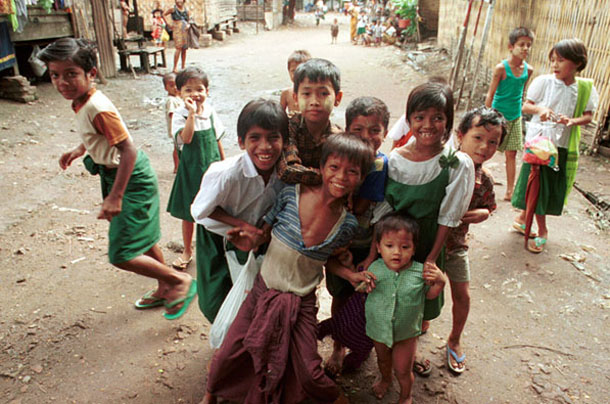
When I look at the picture above what I see is a pure and genuine happiness.  I also can not help but see conditions that from my perspective can seem for below a standard I have become accustom to.   This picture  can conjure a range of emotions with people.  Emotions that can possibly range from happiness due to the infectious nature of their smiles, to the guilt for their less than acceptable living conditions.  Recently I have slowly  been experiencing a a sense of envy, optimism and opportunity.

These emotions have caught me by surprise and are more than likely related to my own internal questions about true happiness and issues of materialism.  Now I when I say that I am experiencing emotions like envy and optimism I am not speaking from a minimalist ideology that promotes happiness through reduction.  The envy I have comes from, or at least what I believe it comes from, is their remarkable ability to produce some much happiness with so little.  In capitalist terms they have an incredible R.O.I(return on investment).  Meaning that i do not believe their happiness comes from having nothing but that they have found a way to either A. produce happiness from very little, or B. challenge or remove the correlation between happiness and typical objects associated with quality of life.

The second and third emotions of optimism and opportunity are linked to this envy.  In this image I see not only lessons but how we have allowed guilt and pity to drive our attempts of charity and help in the wrong directions.  As I mentioned in previously post I have growing issues with preconceived ideas of happiness and success embedded in me.  Along with these I have voiced my concern and acknowledgment that in order to address inequality we have to ask what we are willing to give up.  I feel that these ideas and questions may  be impossible for us to answer or address on our own.  For we have built a system that is governed by a different set of incentives.  This is not to say that they are wrong or that what we have is bad, but just that these incentives produce certain results and that wont change.

So in this image i see an opportunity to not only help but study.  I see a set of values and culture unique from our own.  I see an opportunity build off of this system being mindful and careful to not impact it or corrupt it.  I see an opportunity to learn from them in order to better our selves.  I see an opportunity to not make them like us.

The paradox of inequality

Social issues like addressing inequality go with the architecture field like (insert comparison).  I myself am not immune to draw of these issues as well.  They carry with them a sort of holy grail of problem solving for the problem is so great and at times seems like most efforts are similar to a two steps forward one step back approach.

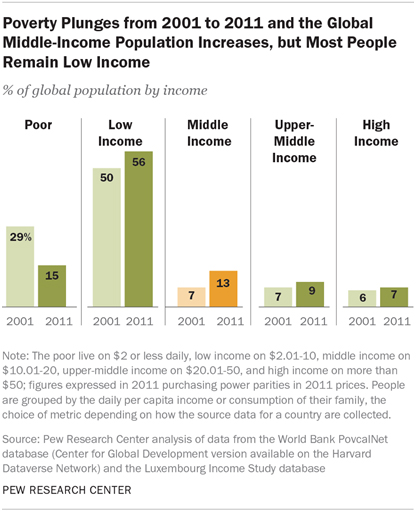
Total giving to charitable organizations was $373.25 billion in 2015 (www.charitynavigator.org).  This is statistic can make one feel warm inside because it is evidence of humanities willingness to give.  But at the same cause concern since poverty and inequality is on an upward trend as seen below on a chart put out by PEW research institute.  Even though the percentage of population considered poor the amount of people considered to be how low income(less than $2 a day) has grown.

PG-2015-07-08_globalClass-00

For me,  looking at this chart brings to light a bigger issue.  Anybody can see that no matter what combination of statics the numbers will add up to 100.  What is not very clear in info graphics like these is the very realistic scenario of finite resources.  this means that the best case to hope for would be perfectly even distribution.  In here lay the problem, as one can see in the text below the graphic that the numbers attached to those categories represent an exponential curve.

So getting back to issue of inequality and how architecture through  NPO’s address it.  It is not a bad thing to want spread American prosperity to the world.  I mean  I am not saying that “we” the good ole USA deserve iphones and caramel lattes and no one else.  Quite the opposite, for instant who even decides if anybody deserves these luxuries, or whether or not another culture believes these “luxuries” improve quality of life.  In a way its almost ignorant to assume they attach happiness to materials like we do.

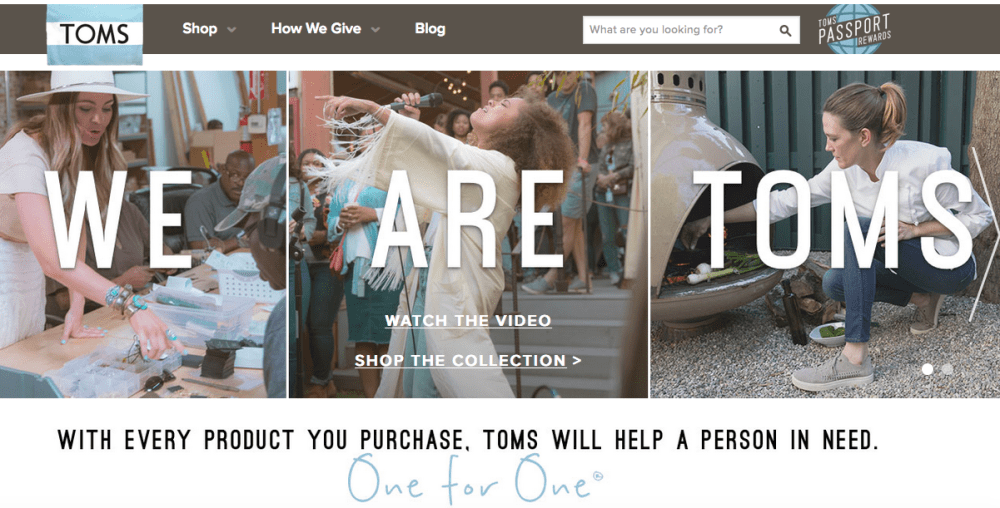
Sitting down to write about this has brought up three paradoxes for me.  The first being that even though I am truly grateful for being born into the circumstances I sometimes question how much happiness or quality of life comes from these “Luxuries”.  Don’t get me wrong I love my iPhone, but i have to question if the time spent checking reddit and Instagram is worth the time im not spending with my wife or family.  The second paradox is that I know that in solving inequality is not as simple as giving people iphones and internet.  In order for me to even afford a cheap iphone some body in a less that fortunate situation has to make that Iphone for far less than i would be willing to do it.  Its the sad truth that part of success is built of the misfortune of others.  The third paradox is the possible ideology behind charity.  Take for example the business model of Tom’s shoes.  Screen Shot 2017-04-20 at 9.00.30 PM

I do feel that the idea behind Tom’s is genuinely good.  It is hard to argue against giving shoes to people in need.  However a problem arises when looking at the slogan.         “With every product your purchase.  Tom’s will help a person in need”.                                      This slogan in a way is oxymoron because in order to give a pair of shoes to someone in need the shoe has to be made by a person in a third world country for a wage that would insult most.   Even with this I know that there is some good in providing jobs and a new possibility for employment for these people.  But…. I also can not help but seem the real transaction taking place and that is guilt relief for material possession.  This is a particularly complex issue, for I am not claiming to be against a business that is prosperous and also does some good and in a way convinces people to be charitable more often.  I am however just pointing out what may be the true motivation behind most charitable actions and that is a way relieve guilt for other wise excessive behavior.  It allows one to thwart  healthy self reflection on whether I need another pair of shoes, or the true value of that 5 dollar latte.

What does this all mean?   Well if i truly am passionate about addressing issues like inequality I have to question what am I willing to give up?


#ThirdWorldProblems

So, My husband has made a great analysis of the main #FirstWorldProblems, and now I will proceed to describe my #ThirdWorldProblems. First of all, I don’t come from a regular third world country, I came escaping from a dictatorship that rejected anything that was not red, socialist or revolutionary. I come from Caracas, Venezuela, one of the most dangerous cities in the world, and at the same time one of the most beautiful ones. Arriving Caracas is like  dating a beautiful famous model with addiction problems and bipolar disorder. Yes, the country is polarized. Yes, half of the people is happy with the status quo of not having enough food, medicines and high levels of devaluation, and the other half, isn’t.

Third world problems are more characterized by the “lack of” something that is attached to a heavy fact: “uncertainty”. Lack of social and health services, lack of water, lack of security for the people, and much more. All of the lacks causes an urgent feeling of hopelessness that is fed by the uncertainty to obtain something that is VITAL for the organism, such as all of the needs that Maslow proposed are the base of a pyramid, that includes water, food, shelter and a sense of safety. Uncertainty gets into a shape of a social tumor that is very hard to kill in third world countries, causing emotional and physical mini crises that end up by making implode the fragile contention walls of patience and survival of any normal human being.

All of the questions exposed in my husband’s text, are questions that I also asked myself many different times meanwhile living in Venezuela; such as: should I be happy with what I have? many people have much less (80% of the country is poor, aprox. ) and I am here whining about……about being robbed several times a year, about not having the possibility to be independent with a regular salary meanwihle having a degree from one of the best universities from your country (UCV), or not being able to just buy a car so I can take my family for a ride to the beach after all of the effort previously done. Yes, I was 30, and I never had a car in my life. Went through high school, College and Work without needing a car. Is this hard? yes it was occasionally, but of course, having a benefit in poor countries is also a threat. The threat of uncertainty, it might get stolen, and you might end up dead by a piece of metal made in China.

So, 1st world problems are the ones that 3rd world people wish to have. 1st world problems are not much related with “lack of” or “Uncertainty”, they are created by clashes between objects, beliefs and functions that seems not to match, or seems not to express happiness or being able to give positive reinforcements. The “Lack of” and the “Uncertainty” to obtain seems not to be there. 1st world problems are more related with the hardships to keep supporting the happiness that we have through the “reinvention” of objects. No more simple Black coffee, More caramel macchiatto with coconut milk. No more Blackberry’s, More and new adapted to our “needs” Iphones.

No more simple computers, More laptops that you can carry, break in half, sign to them and have smart replies when you don’t have anyone to talk to. 1st world problems are more complex, and they get more specific because the availability of the components is there, and there is no uncertainty. When there is no uncertainty, boredom comes to fill up the life of the regular 1st world citizens. Certainty is desired by the 3rd world country citizen to be happier, and the lack of certainty seems to be one of the reasons of boredom in first world countries. Of course, 3rd world country citizens feel thrilled with whatever thing they have obtained, the uncertainty is reduced. 1st world country citizens feel thrilled when certainty  is replaced with new and improved things, because they truly deeply know, that dealing with uncertainty can be severely debilitating for mind and soul, as they watch on TV and news from foreign countries. I do understand this point of view, because this is what I wanted. I wanted certainty, I wanted peace.

With all of the previously exposed, I wanted to express that, It does not matter where you were born, or where you live, you will always have this constant dialog of happiness-unhappiness, constant comparison with others (coworkers, relatives), should I be happy with what I have or should I strive for more? Probably the answer is in all of us. a balance of having what is basic to life, and a challenge to obtain only the things that are really important to us (material or ethereal).

#firstworldproblems

I’m going to preface this post by stating I have never been abroad and my life experience is limited to the US.  With that said I find my self growing more and more curious and almost envious of other cultures and the lifestyles or assumed life styles and value systems.

The Hastag firstworldproblems was introduced maybe a year or two ago and is a product of our post modern/ironic culture here.  With this hastag people make observation of situations that are supposed to be little annoyance of living in a first world country with quotes like:

I hate when I run out of things to look at on my phone before I’m ready to go to sleep 🙃


Statements like these are meant to funny and some what enlightening of our fortunate situations.  In a half joking have serious kind of way.  Statements like Firstworldproblems fall into same area as a humble brag for me because  ultimately they lack sincerity and the enlightened insight that they attempt to convey,however ironic it is.

Recently the Firstworldproblems campaign took on this problem by producing a video were people who actually live in “third world” countries read back post with the hastag, therefore pointing out the ridiculousness of American excess.  I can only assume this campaign’s aim is to force people to think about the own bloated lifestyles in comparison to other countries.  Also the might possibly get some to engage and donate to causes that help.  Which by all means is good but…….

I feel like there may be a bigger issue lurking within this simple hastag.  For me the real problem I have with it, is that it brings to light all that is wrong with our perceived happier more successful “first world problems”.

Like the statistic that 767 million people lived on less than $1.90 a day.   I really do not know what is more troubling about this statistic.  The fact that I know that my first world life is made possible because 767 million people live on less the $2 a day or that I immediately  make an assumption that these people cant be happy.  Or that i have a better life than them.  Or the fact that my selfish pursuit of trivia material objects is responsible for the financial  suppression.

We reside in a system that has produced great vast amounts of wealth.  But i do not feel that directly translates into happiness.  I admit I thought that this system would generate happiness and success for me.

I Recently graduated from graduate school with a masters degree in architecture. After which I moved to a city and excepted a job in my field of study.  I studied  long hours while working 1-2 jobs through college and lived in a small apartment because I wanted to better my life.  I choose this route because I enjoy furthering my education but also because it is the American path for success.   Well now that I’m finished and moving into the next stage of my life I can say that i do really enjoy the city i live in and the house I rent is a great upgrade from my previous place but….   While i do live in a big city and a nice house, These things cost more and because I choose to pursue higher education I now have 70 + thousand in student loan debt that I will have to pay off.  All in all I feel like I am in the same scenario with different, albeit better scenery.

Ultimately I realized I  enjoy the vibrancy of the city and the unique sites I get to see.  I enjoy the people and the culture.  I enjoy time spent with my wife and when family visits in this positive environment.  Not the  cost of this  huge debt, unnecessary amenities, and the stress of bills living paycheck to pay check. I set out on my journey to success by pursuing a false baseline for happiness and success.  Set not by myself but by our own collective society.  I have realized everything that most things that make me happy don’t cost and the things that cause me stress and anger are in a way self inflicted.

In a way we pursue happiness through inanimate objects and material based pleasures.  We have built and engineered a system that demands it.  Its the same system that brought us to where we are today as a country.  It is also the same system that relies on exponential growth and things like for profit,    well everything.  All in all i question whether we are as happy as we think?

This brings up tough  questions for me.  Like how do i feel knowing that my elevated lifestyle is directly proportional to someones lowered lifestyle?  Or the fact that life choices i make don’t necessarily lead to happiness and may lead to the opposite.  Its making me consider why these people cant be happy with 2 dollars a day.  I have no idea how happy they are.  I can only judge from of the money the make which is now our ridiculous barometer of happiness.

……So yeah its complicated

WHY CARE?

This week I was listening to a podcast called Invisibilia while working on projects.  The episode that i was listening to was titled something like Frame of reference.  In this episode they at three segments in the first one the host introduced the episode by talking about how important reference or context is in shaping the individuals world.  This context is what often leads to misunderstandings of how people can perceive things differently  and how some may come off as insincere to someone’s situation.

Of course as i listened to the podcast I thought I knew where they were going with this.  Maybe they would tie it into the recent political environment or social/cultural rifts.  I was however wrong as the host began the next segment with an interview of a comedy central news show correspondent Hasan Minjah.  In this interview  the host and guest spoke of the relationship with immigrant parents who viewed the world from a completely different perspective or reference that at first glance seemed to belittle their daily concerns or struggles.  I found myself empathizing with both of them and and making connections to my own experience with people in my life that seem to lack the ability to see things from my perspective.

While listening to this podcast I couldn’t help but think about a act on Dave chapelle’s new comedy special.  He begins by talking nostalgically about the care bears and how they solve problems by using their super power which was caring hence the name.  As i kid i never really thought much about it( the care bears), hell i didn’t even remember that caring was their super power.  Back then it really did not seem like caring could be a super power.  I mean come one every one has the ability to care or have sympathy.

With that thought running through my head the third segment began with the introduction of a 54 year old doctor who began to tell the story of her childhood.  She told the story of a troubled childhood as she struggled to fit in and always tried to figure out ways to adapt and almost treated it as an experiment or investigation.  She eventually figured out ways to make due socially and chalked up previous experience to her higher intellect being hard for others to understand.  Well the story takes a turn once the women discovers she has Asperger’s disease.  She comes to this conclusion by taking part in an experimental medical therapy for depression.  This therapy involved magnetic pulses that would activate certain regions of the brain.  A set of questions and phases where presented to her before as a control and after the therapy to measure results.  These question and phases were set up to mimic real life scenarios that were examples of heightened emotions ie. fear, happiness, concern.   The guest discussed one of the examples as a some one “asking is that a gun?”.  It was not until after the therapy began and the same phase was presented again that it was a person being robbed in this example.  This context was totally new to her as before she read the statement as if it was a generic question with no emphasis or concern.  She was overcome with emotions that she had never felt before and suddenly realized that not only was she missing a significant part of human interaction but that all of her childhood troubles to fit in more than likely stemmed from her minds inability to pick up on subtle emotions that conveyed what a person is truly communicating.

At this point I realized that I my self have not truly appreciated the ability to care.   This women, who never experienced it before presented it like it was more than just a default ability to pick up on subtle emotional cues inherent in everyone.  It was a super power.

First blog post

This blog is intended to be a collection of thoughts, feelings and personal opinions that arises everyday in our magically and ordinary life. We are Thomas Mouton and Toscana Navas, we are a multi cultural couple living in a world that tries to isolate itself inside of digital screens and massive plastic cubes of food. Thomas Mouton is from Carencro, Louisiana, a small town where he grew up trying to become a rebellious bayou hipster, and Myself, Toscana Navas, A complex Latina women born in Caracas, Venezuela (one of the most dangerous cities in the world) that loves carbs and ridiculous old movies with bad effects. Thomas is an Architect, And Toscana is a Psychologist (in Venezuela) and a future counselor in the United States. We are both in our 30s (we will not specify the the second digit) and we are thankful with all of you for stopping by and read us and make us part of your life (Always hoping that in a good way). Thank you for stopping by!