The Joker: a new archetype?

(Spoiler Alert)


The Joker is the new famous movie about a failed comedian named Arthur Fleck that works in a clown company at Gotham city that gave Joaquin Phoenix an oscar for best actor in 2020. The story might sound simple, but it is a very complex and intrincate film that mixes psycho-dynamic and sociological elements by exposing the drama of failed mental health services inside of an anemic society that reflects the fragility of the human psyche.
When we take a look at how the society is portrayed on the film, it seems that there is not too much of a difference between Gotham city and the United States. This is evidenced on the deep gap between lower and upper socioeconomic classes that is reflected closely when showing the hypothetical relationship between the Joker (the poor) and his “father” (the rich and powerful father of Bruce Wayne). The Joker’s mother also suffer from deep mental diagnoses, but this is something that he is not aware of as a son. The movie also shows how the Joker’s mother was neglecting his son due to her psychiatric conditions and allowed him to be exposed to violence at home as well. Johnson et al. (1999) demonstrated that childhood neglect and physical abuse (But not sexual abuse) predicted an increased prevalence of adult antisocial symptoms. The mother makes his son believe that he is the son of this rich character (Thomas Wayne), when this is not true.
It seems that the breaking point for the Joker is the moment when he realizes that he is not his father’s son, and his mother is also not his mother; he was an orphan. This takes the Joker to kill his mother, using a narcissistic resource to kill the reality that he doesn’t want to experience, which can be understood as a psychotic element. Here we can find evidence how there is no space for grief or any pause for reflection of this painful discovery, showing that killing is the only way to suppress what it is not wanted. This is a reflection of the extreme pathological elements of an antisocial disorder and narcissistic personality disorder. The narcissistic elements seem to be mixed with psychotic elements that are evidenced when the Joker loves to act as if he is famous and loved in recurrent fanstasies, showing a superiority complex based on psychotic grandiose delusions. This is also showed at the story when he creates a delusional and non existing relationship with his neighbor. Lets go back to the relationship between the joker and the anomia experienced on Gotham City.
Joaquin-Phoenix-Joker

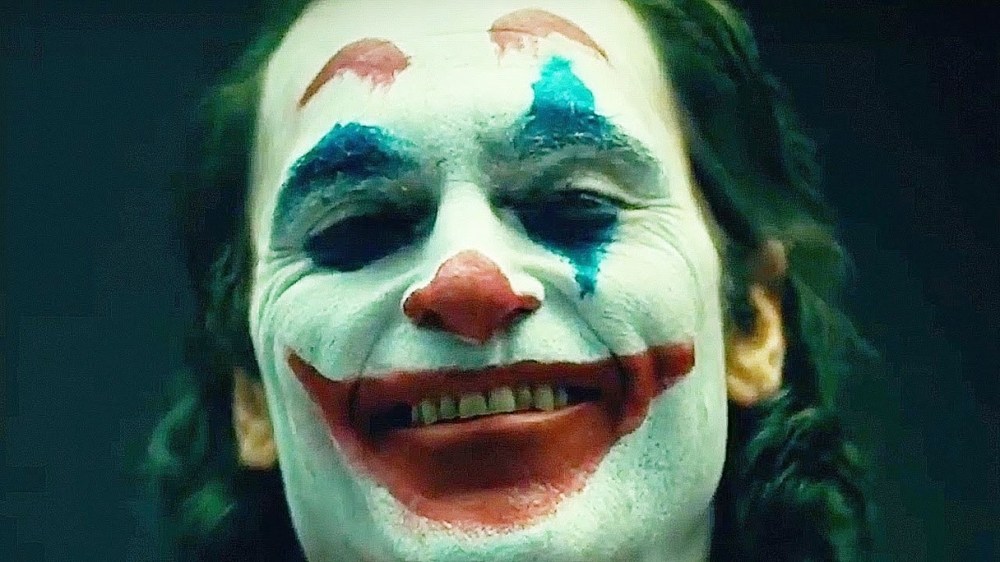
The moment that the Joker kills the show host (Robert DeNiro) on live television is when a revolution begins on the streets of Gotham City. People goes out to the streets to vandalize, destroy and kill wearing clown masks, almost like reflecting the logo or symbol that represents the revolution of the lower socioeconomic class against the higher up class in power. The individual becomes an unidentified clown, a clown that nobody cares who is angry, a complete explosion of “ID” from the psychodinamic point of view. It is interesting to observe that at the moment that individuals wear a mask in front of others, they are hiding themselves of who they truly are, which makes them free to really be themselves.
This is one of the most poetic contradictions of the film. When society takes the joker as “God”, the antisocial traits of this character are validated, and the main symptoms of the antisocial personality disorder of this leader are translated into an anomic revolution. This seems to be a reflection of the different historical revolutionary process that occurs when antisocial leaders guide society towards a desctructive pattern of death and destruction of human rights.
This film also reflects how the elites deny and suppress the suffering of the proletariat, as well as the despise for mentally ill individuals. The joker seems to represent the dark side of society as a new archetype of the poor, the ill and psychotic individual that attains power by killing and destroying anything that doesn’t reflect what it is desired to experience. There is one scene where the elites are attending to the movie theatre for the premiere of the movie modern times of Chaplin. It is widely known that this great film depicts the drama of the industrial revolution and its effects on the human psyche in the shape of a comedy. sadly, this is one of the few accepted ways to show publicly the disparities between the working class and the elites, something that it seems to be attempted as well with the Joker.

JKR_DAY034_103118_0762417.dng

All the audience laughs at the movie (it is expected, it is a comedy), laughs at the poor and the oppressed because it has been sublimed through art, an acceptable way to approach to the suffering of poverty. The previously described is also reflected on the forced smile of the joker. We must laugh of our own suffering, even when we want to cry, something that is commonly found on modern self-help psychology, forcing the individual to have an optimistic point of view of their own suffering that is partly caused by societal constraints that are almost impossible to modify.The happy clownish mask of the joker serves as a negotiation between the wild needs of the id (unconscious entity of the psyche that deals with instinctive desires) and the struggles of the punitive superego (conscious entity that entails morality and introjected social norms).
Therefore, the mask becomes the Ego (the mediator between the “ID” and the superego), the middle ground that deals with the clash between the antisocial drive and social norms. The expression of forced laugh can also be seen as a manic coping mechanism against depression. It is almost as if time as a variable disappears from a bipolar disorder and mania and depression occurs at the present moment. Meloy (1988) argues that another aspect of superego pathology more characteristic of the true psychopath than of the higher level narcissistic variants is a complete lack of effort to morally justify or rationalize the antisocial behavior, something that is evidenced on the different murderers perpetrated by the Joker. He actually feels euphoric and full of energy after killing without even rationalizing about the nature of the event.
The film also exposes how mental health services are not a priority in society. The despise for mental illness is evidenced on the extreme antisocial and narcissistic personality disorder of the Joker, which represents the darkest and unpredictable side of the human psyche that needs to be contained and hidden. Glenn Gabbard argues that antisocial patients are perhaps the most extensively studied of all those with personality disorders, but they are also the patients whom clinicians tend to avoid the most. The most clear scene of this matter on the film is when the Joker meets with his social worker and she informs him that he wont be able to get anymore services (including psychiatric medications) because they are shutting down the health services. The Joker replies to this with “They just don’t care about me” to what the Social worker replies “They don’t care about me either”, another sad reflection from the actual mental health situation that the United States is facing.
Coronavirus, the king of Pain

Toscana Mouton Navas
petitetoscana@gmail.com

Nowadays it seems that nobody can remain ignorant to the coronavirus. It’s all over the place, everywhere, an invisible entity that covers all the corners of the world, waiting patiently in silence for the next victim. Is this a natural virus? Is it manufactured? Is it intentionally caused with premeditation to end the elderly population? How long will it stay with us? So many questions with thousands of different answers. The matter of fact is, we just can see the tip of the iceberg from our window, the rest of this biological horror is hidden. I think there is only a couple of questions that can be answered by the thread of logical reasonings, and one of them is: is the virus changing us as a human race? Indeed, it is. But for how long? Perhaps forever.
Death as part of life

image2 copy

“He who is not busy being born is busy dying” (Bob Dylan)
The Coronavirus is here to remind us about how fragile life is and slap us in the face to be conscious about the possibility of dying. This can create a tornado of inner feelings that can produce death anxiety. We desperately collect all of those things that remind us that we are alive, just like food and the end of it (toilet paper). It is not only the fear of us dying, but also the fear of the world dying as it is, the version that we consider comfortable and predictable. We die a little bit more every day, but we also celebrate the end of the day by going to that world of dreams and nightmares every night. But, how such a little invisible thing can kill more than Hitler, without compassion, but without preference? How can we deal with this invisible enemy that we don’t know how to eradicate? We are each time closer and closer to the world of the spirits, using alcohol as holy water to eradicate the demonic entity of this virus.
Collective unconscious

image3

“The Collective unconscious consist of the sum of the instincts and their correlates, the archetypes. Just as everybody possesses instincts, so he also possesses a stock of archetypal images” (Carl Jung).
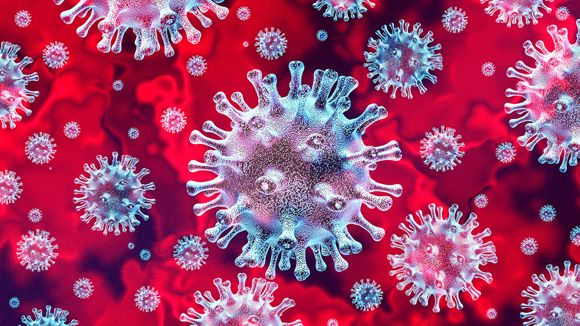
There are different archetypes that live in por unconscious mind (such as the mother, the father) and many more reflected in myths and legends that are represented in the shape of images. But then, what is the archetypal image of the virus? We have seen thousands of times that grey round ball with tiny pretty red flowers on the surface as the shape of the coronavirus. The present generation might generate an adverse reflex towards anything that resembles a dark circle. This is such a paradox; we can see the virus on TV thousands of times but we cannot face it in reality. That enemy that is, but at the same time isn’t, almost promoting a psychotic way to approach the world. so, how this generations will face this archetypal image of a virus? Will this be transmitted to future generations? Will this virus haunt our dreams, our decisions and motives for life in an unconscious level? It probably will.
Tactile emptiness

image4

“Touch seems to be as essential as sunlight” (Diane Ackerman)
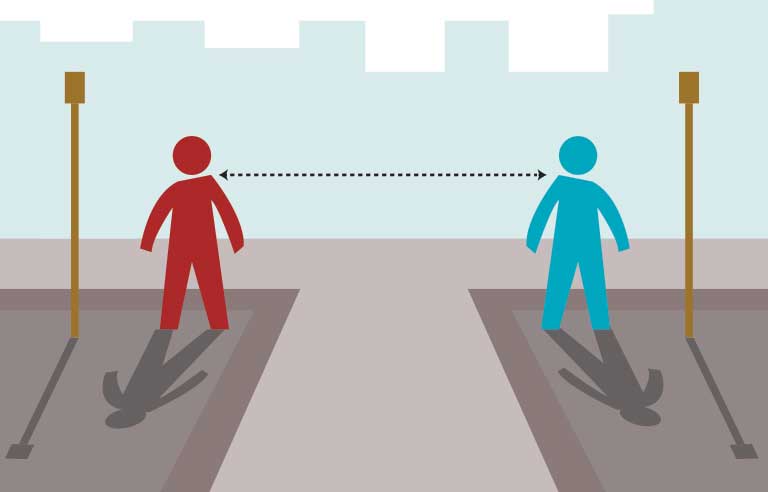
The social distancing that we are experiencing will have definite consequences in the long term of mankind. Think about the pregnant mother without the touch of their family or friends, and how that baby will experience the serotonin reduction on her mothers’ blood. Think about that child that stares through the window for months, anxious to touch the spring flowers, the dogs passing by, the hands of its grandparents. That lack of touch makes social connections rusty and dry, empty and simple. The language will have to safe us in its infinite enrichment of words to transmit what we feel. That couple that cannot touch each other and gets sick of sadness, we will probably see a lot of depressed skin, waiting to be touched again, even for that stranger on the bus that holds your hand when you loose balance and almost fall. Will these change us? Yes, I hope for the best. Perhaps we will start giving much more value to the contact with others now more than ever.
The eye kingdom

image5

“A man’s feet should be planted in his country, but his eyes should survey the world”. George Santayana
The recognition of the baby though the eyes of the mother is the first step to the acknowledgment of being alive and being loved. The eye to eye connections that we are missing in our daily lives are reducing our awareness of being a living and sentient being. People watching you as soon as you go into the subway or that person that looks at you that will be sitting next to you on the plain are situations that helps us acknowledge that we exist, we are important, and we have rights. Without spectators, the theater of life loose its sense of existence.
Nature can breathe

image6

“I think that I shall never see a poem lovely as a tree”. Joyce Kilmer
We have been spectators of how animals have returned to natural habitats and how they are also “invading” city spaces. We selfishly call it invasion because that’s our “territory”, but now we realize that “our” territory is the stolen space that we took from nature to modify it to our taste and live in it. Is the coronavirus the virus of the world, or is it us? The delimitations between the urban world and the nature world are progressively disappearing to make us remember that we are part of nature, not only from a social and cultural structure. Will the animal behavior will change after having more freedom and less human intervention? It is more than likely.
Work/Study from home

image7

Yes, it is possible to be self-reliant and efficient from home as well. Of course, there are so many professions and occupations that cannot exist working from home. The stigma of the education through internet as inferior will change, as we can even see that Harvard and Oxford will teach online. Our perception of education and work will change now that there is evidence of the fact that humans can be free from the office, they can also be efficient and responsible, as well as students.
The perennial tragedy of distance

image8

“Your memory feels like home to me. So, whenever my mind wanders, it always finds it’s way back to you” Ranata Suzuki
Distance is a painful symptom that immigrants and refugees experience every single day, and now more than ever, isolated families are experiencing the same feelings of the immigrants by being away from their own family, but in the same territory. Elderly parents waving their daughters and sons through the window of a residence reminds me of me and my mother waving at skype from different countries. Globalization and the frequent mobilization of people throughout the world to find a better life or to have their basic rights respected have created a more disconnected world than ever before. Perhaps I hope that people will become more sensitive towards immigrant minorities all over the world when they experienced the same pain of distance and hopefully governments will take measures about this. Sadly, the most likely is that the governments will strengthen their borders to contain this virus or other future diseases.
Future phobias

image9-2

“Fear makes the wolf bigger than he is” German Proverb
As we already know, there are people that call themselves “germophobes”, and in some extreme cases, we have the cases of hypochondriasis, nosophobia, and other more extreme cases where a psychotic or manic breakdown can contain coronavirus elements. People struggling with mental health diagnoses could be affected for a spike of tremendous fear and anxiety towards the coronavirus, and It will be possible to see a spike of terror reflected on children’s drawings, psychiatric offices, murals and hygiene habits in the entire world. Mental health professionals will experience a higher percent of cases related with terror to this disease, mainly when someone loses a child, or a parent due to the coronavirus. Our relationship with germs will be affected permanently. Germs and viruses won’t be ignored as they generally are, and they will be part of the dark side of our psyche.

Religion as a passive spectatorimage10-2


“When I do good, I feel good, when I do bad, I feel bad, and that’s my religion” Abraham Lincoln
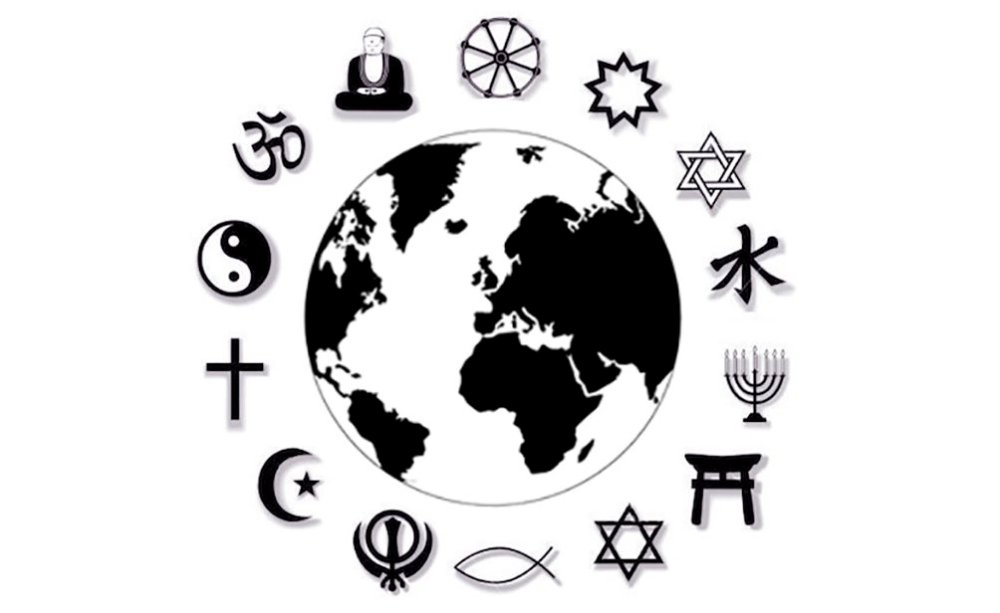
With the containment and isolation that the entire world is experiencing these days, religion makes a U turn towards inner spirituality. The absence of congregations in religious spaces and also the absence of community and charity work will turn our beliefs (or lack of) inwards. We can think about these situations as a Tsunami. When an earthquake hits, our spiritual believes leave the shores of certainty, leaving an empty space of reflection and fear, waiting for a waive of uncertainty in God, Allah and buddha. The saints sit and wait for the prayers of the believers, the undead can hear the whisper of their living relatives calling for them. It is inevitable to experience an inner tsunami, as passive spectators of the catastrophe.

Darwin is laughing

image11

“I was taught that the human brain was the crowning glory of evolution so far, but I think it’s a very poor scheme for survival” Kurt Vonnegut.
As we know from our biology classes, Darwin dictated the rule that defines our existence. Change and adaptation are necessary to survive. The coronavirus is pushing us as biological beings to modify our DNA structures to be more resistant to the ever-changing environment. I can only imagine Darwin in 2020, laughing of us, talking with CNN and Fox news about his theory, terrifying the crowds and giving little hope for the situation, accepting the situation, and perhaps hoping very deep inside of his soul for God to show up and fix all of this mess that we got into.

Graphic Meaninglessness

The Architecture presentation has become, what seems like an ever growing crucial aspect of project and can subsequently signal its success or failure almost before the initial idea fully gestates into something real. A project can go on to become a success built piece of architecture or it can for ever exist as a grand idea purely based on ones ability to convey the potential projects merits through presentation. The importance of presentation is partially born out of necessity in academia as each semester typically consist of a conceptual project that culminates in a final presentation with professors playing the role as clients and critics. The ever growing complexity of projects and issues that architecture attempts to address has subsequently promoted the architectural diagram as the ultimate form of conveying a grand overarching idea. Recently these diagrams have become more than a pretty graphic to explain context and design choices and now more often than not embody the projects design ideology ,even in some cases appearing to be used as a tool of design.

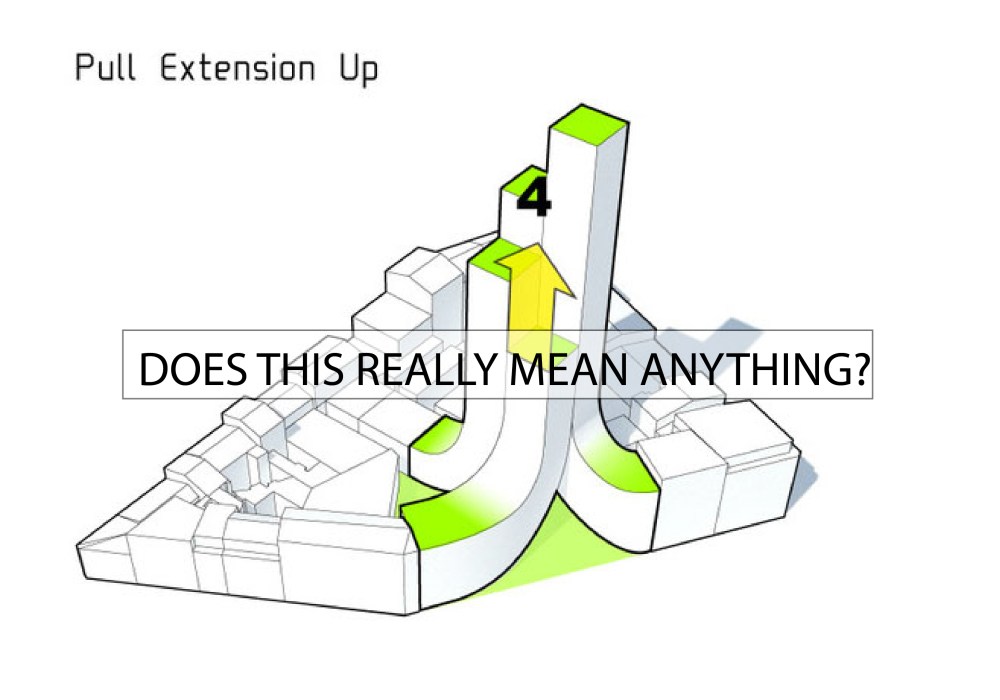
REX is a firm that utilizes diagrams to present the design ideology behind each project. Obviously this firm is very well known and therefore one could say they are very successful in the ways that they use diagrams to present the ideology and design choices behind each project. I have insert a few of these diagrams from their Canti-lever House project in New York.

Screen Shot 2019-08-31 at 2.48.40 PMScreen Shot 2019-08-31 at 2.48.59 PMScreen Shot 2019-08-31 at 2.49.16 PM
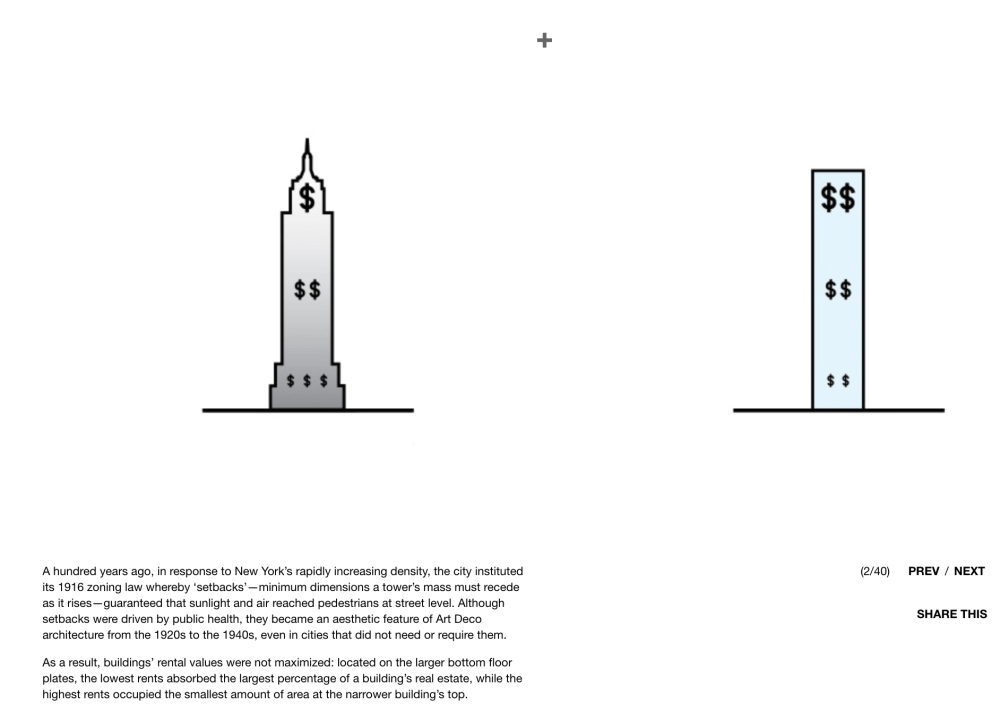
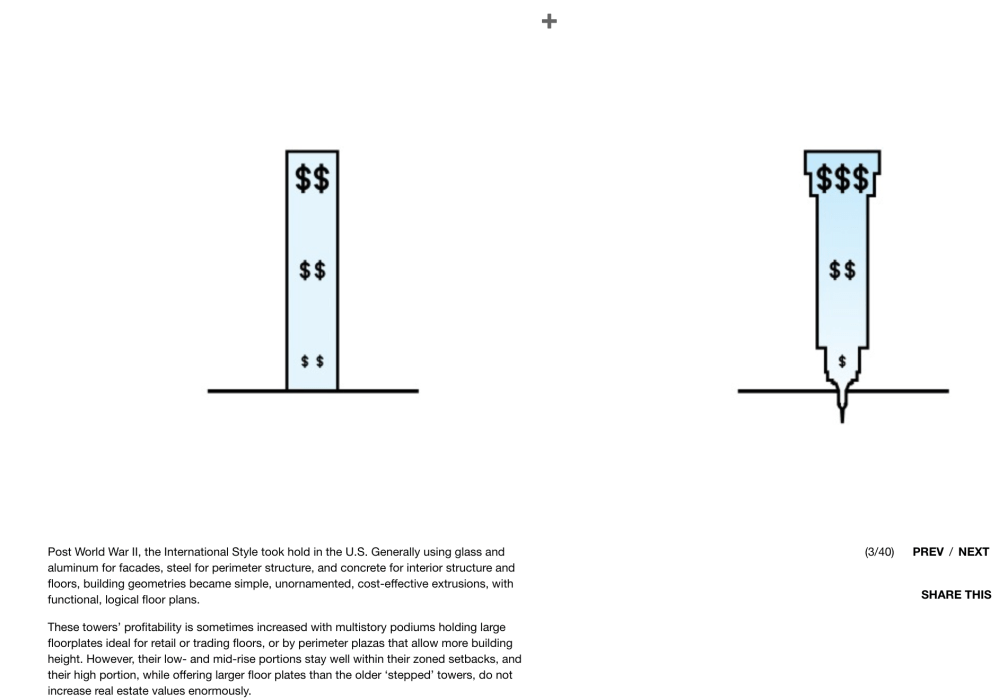
The Diagrams for this project tell a story of how design aesthetics and construction techniques in the early 1900’s drove a programmatic layout which was bottom heavy and in-turn was a model that did not capitalize on up scale/high paying tenants. So the solution of inverting the form and with it the programs becomes obvious and almost predicted with the second diagram. The final diagrams finalize the intended form and are not really crucial to selling the idea. It truly is impressive how well this works on most of their projects and it is easy to see why it has become almost a standard for successful project and firms.

Ultimately the simplicity and clarity of these diagrams is what makes them so successful. With each project comes what seems like a new language, created to with the sole purpose of conveying a design ideology or idea. Relying on shapes and forms combined with minimal text and info these simple graphics can in-turn appear to say so much with the key word being appear. Each diagram appears to say so much not through the presentation of a great quantity of information but through the removal of it leaving only the desire info needed. Of course the author of each diagram understands the full context that lay hidden behind each diagram but the same can not be said for the outside observer. Most of the time this may not be a problem however i believe that this growing fixation on the diagram as design tool has an unintended effect of alienation.

This alienation comes from the abstractionist of subtractions nature of the diagrammatic architecture in two forms. Firstly alienation comes from the removal of information and therefore context, and the second comes in the form of the alienation of the human. In most case these cases present a final form or shape and present architectural intervention as merely an object or form. The latter issue is something i believe inherit in the design as we fly around in 3d computer programs playing god as we hypothetically create and destroy at will. The very nature of these programs not only allow us to increase our efficiency but also they allow us to see our design from perspectives and vantage points foreign to anything remotely realistic for the human eye.

I believe this to be similarly true of each of diagrams referenced from the REX project above. By presenting the architectural form with a programmatic economic overlay the message becomes more about economics as a spatial driver. I believe this to be a gross over simplification of the economic driving forces behind architectural design and real-estate in the early 1900’s and while also reinterpreting the established laws of supply and demand. If I’m not mistaken scarcity drives demand and therefore prices etc. It seems to be an ever persistent problem within architecture as each designer takes the position that through design you can have your cake and eat it too.

One architect Bjarke Ingles has even tried to build his design manifesto based on this idea of having it all. He calls it architectural bigamy, an idea he describes as “A pragmatic utopian architecture that takes on the creation of socially, economically and environmentally perfect places as a practical objective”(Yes is More TACHEN 2010). It is no surprise that Bjark’s firm BIG has become a big proponent of the diagram as a design tool. He has become a master of it and uses it to tell a story as if it is language in and of itself. It is not a language however for it lacks syntax and a system of rules. Languages typically are accompanied by some syntax or rules that define and set parameters making their meaning objective and agreeable. These design diagrams have no syntax they are creatures born of their creator’s conscious with the sole purpose of acceptance and objective agreement. They satisfy architecture’s need to shed its subjective aspects for it is afraid of its own shadow.


The hidden meanings of the movie Us (Spoiler Alert!)

ec788678-fbdc-45b8-b0d8-c375853ed747-large16x9_US_Fin1Sheet_2M.r1_rgb

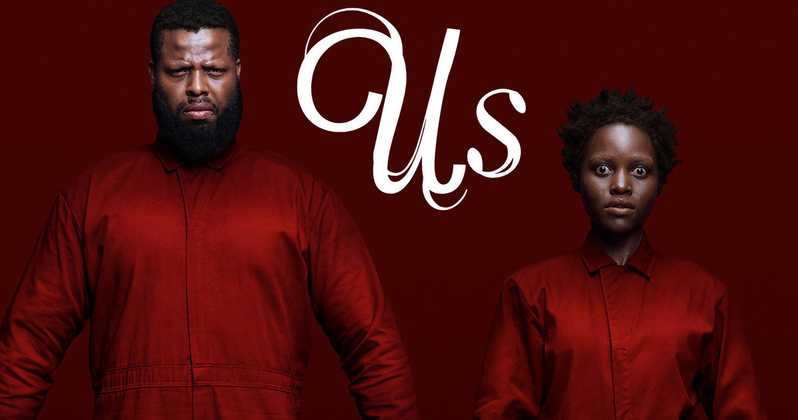
The new movie “Us” directed by Jordan Peele could be seen as a masterpiece of “odd” suspense that is drowned in deep symbolism of what is happening to the American culture in the present time. As it is explained by the description of Wikipedia, the movie Us is the story of: “Adelaide Wilson, a woman who returns to the beachfront home where she grew up as a child. Haunted by a traumatic experience from the past, Adelaide grows increasingly concerned that something bad is going to happen. Her worst fears soon become a reality when four masked strangers descend upon the house, forcing the Wilsons into a fight for survival. When the masks come off, the family is horrified to learn that each attacker takes the appearance of one of them”.

As soon as we can read these lines, we are hooked up on a suspense story that doesn’t reflect absolutely anything about politics, religion or racism. I personally love suspense movies that are “well done” and not “medium rare”, those that unfold things slowly, paying attention to details and that makes you crave for the end of the movie to feel some sort of relief from so much suspense. Well, the movie “Us” is this and more, because of the intense play of fear and unconscious hidden elements that are revealed to the audience, making it a “strange” or “odd” movie that sometimes doesn’t seem to make much sense, such as life itself. This movie can be very upsetting for people that enjoys an easy story with a clear development and end, so if you feel that you can stand the ambiguity of the story, this might be a good movie for you!

I have checked some of the analysis of this movie, and I do have to agree with the fact that the title “Us” is much more a reflection of “US” as the United States, something that can be deeply appreciated on the film. The movie initially takes you back to the 80’s, to Adelaide’s childhood. She decides to stay away from her parents for a couple of minutes and ends up going into an attraction of the amusement park where it reads something like “to find yourself”. I have been trying to google the image of the attraction but I can’t find it. It has a Native American character on the entrance, and it looks very dark and mysterious inside. Indeed, Adelaide finds herself in this cave, but why is this a scary situation to the point of feeling terrorized? Perhaps because Adelaide has witness the shadow of her own past, the one that she is not aware of until that point, the point where she learns that there is a dark past in her history as an African American that is haunting her.

Us-Movie-2019-Banners-Posters-Tethered

After this, Adelaide could not talk, developing PTSD after this experience. If any African American could find themselves one day back in the past, they would come back on the same state, or even worse than Adelaide’s conditions. After this, the movie jumps to the present time. Adelaide got married and had two children. They are spending some nice time of vacations on the beach, but Adelaide doesn’t want to go to the beach, to the same amusement park where she experienced the trauma that caused her to suffer from Post Traumatic Stress Disorder, but she still decides to do it for her family. She was feeling deeply paranoid on the beach, and she was afraid of her young boy to get lost in the same attraction that she did. The boy encountered a strange man on the beach standing with his arms open, a complete unexpected and weird element of the story. Adelaide’s son was able to walk nearby the same attraction where she had her trauma, but she found him on time to prevent him to get in. this can reflect the difficulties of African American parents when they have to reveal the story of their past to their children and how hard this can be for the parent and for the children.

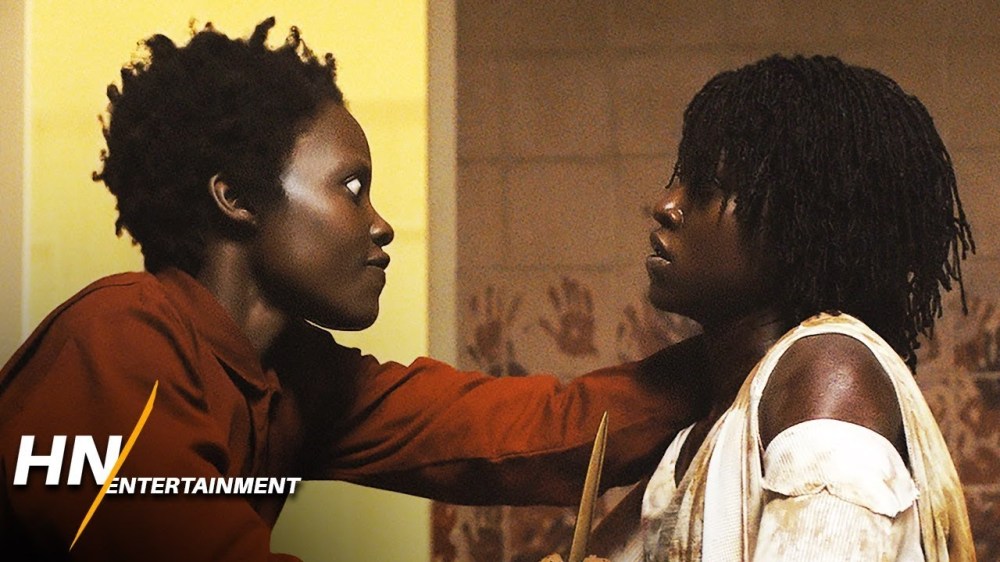
The attraction does not show a Native American anymore and it has been switched for Merlin the Wizard. After what happened, Adelaide decides to go back home. When the family is back to the house, they started to experience the terrible phenomenon of being kidnapped by four strangers that are the creepiest version of themselves as a family. The creepy family version decides to break in to the house, and they want to possibly hurt and kill the original family. The only family member that can barely talk is the version of Adelaide, something that is explained at the end of the movie. The rest of characters cannot talk. When the family starts to run away from their cloned creepy family, they end up separating with their own version. We can ask ourselves why they are carrying with them a pair of scissors to kill?….what does this mean? Scissors main purpose is to cut, or “divide”. This can be a reflection of how the past is coming to haunt us (Racism) as a dark version of ourselves that will kill society by dividing it. The family is reunited one more time, and they decided to run for help to their white or Caucasian neighbors. Before this happens, the family has been killed by their own creepy versions and now the only survivors are the mean versions, the shadows of the racist past of the American history.

One of the meanings why the cloned creepy versions of everyone cannot talk could be the symbolism of how hard it is to talk about the racial history in the United States, and how everything should be kept quiet to avoid conflicts. Adelaide’s family had to kill the creepy family to survive, and they learned by watching the news that what is happening to them is happening to everyone. One main important thing is that is seems that you cannot kill the creepy characters. Why can this be possible? Perhaps because there is no way to escape from history, and history never dies. When we see the interaction between Adelaide and the replacement of her Caucasian friend as a creepy entity, we appreciate that she doesn’t kill her, she simply put handcuffs on her so she wont escape. This can be an underlying symbol of slavery.

maxresdefault

When the family is trying to escape themselves from their own evil versions, the evil version of Adelaide takes her son, and she is faced to go back again to the cave of her past to look for the son that she lost. When she finally gets into that creepy place, she founds herself with weird people on the time of the 80’s that are not talking and they act in a “zombie mode”, perhaps reflecting how history is preserved in the collective unconscious of our memory. Adelaide looks for her creepy version walking in a strange white tunnel that is full of bunnies that have been released and are free. We can notice how at the beginning of the movie the bunnies are caged in a classroom. This can be a symbol of how education is creating naïve people that might be blind to the horrors of the American History back at the time, an even when they are free, they remain being naïve.

When Adelaide finds her creepy version, they are in a classroom. They fight for a long time, to finally discover that Adelaide is the actual copy of herself, and the true Adelaide is the actual creepy version that stayed inside of the main attraction park. This is a very confusing moment, where it is possible to think that the real Adelaide stayed buried in the past, and the past started to eat her own voice and freedom, meanwhile the other Adelaide was enjoying of living in the future time, without the horrors of the inclement history of America. When Adelaide achieves to leave and go back to her family, her son realizes that Adelaide is not herself, it was always the other version of herself…(Spoiler alert).

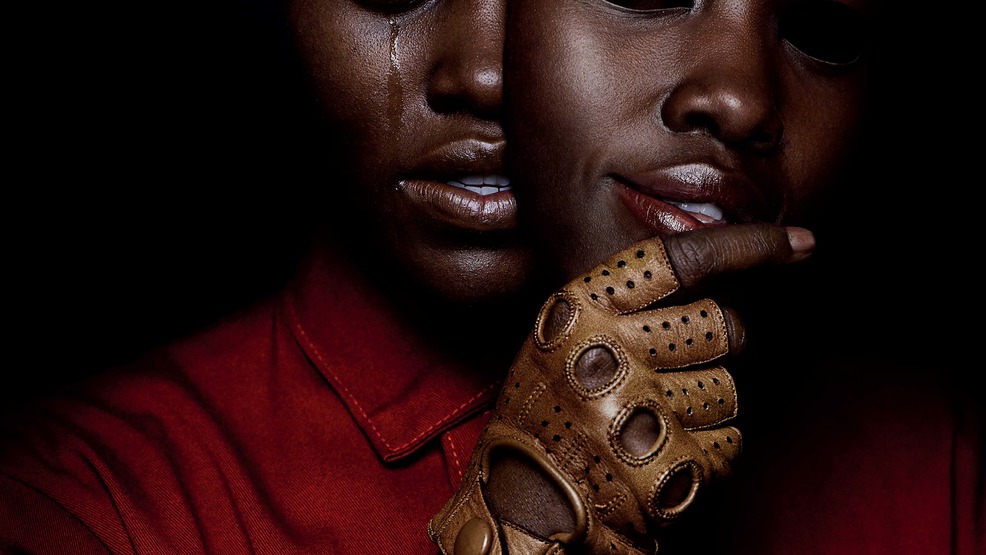
On the final scenes, we can observe how all of those creepy versions of humans are gathering in a line, grabbing each other by the hand, almost creating a wall. The past and the racism are back, and they are united forming a wall to set up limits to something that we were never saw on the film. This can be an actual representation of the wall that president Trump wants to build. Everyone is united as the past version of themselves to create this wall, and each of them are holding scissors on their hands, as if cutting or dividing the country. This is an interesting element where it is showed that these evil characters are united by dividing. The streets are crowded with dead people that has been replaced by the Racist past version of themselves. At some part of the movie when the family is making plans to escape, Adelaide wants to go to Mexico to run away, but her husband doesn’t want to because they are more safe in the United States because the have everything they need, such as water and electricity, something that Adelaide replies: Are you sure that are we much safe here? Another reflection of the political climate that we are experiencing in the present time. Another analogy to why are they dressed in red and they all have gloves in their right hand and wearing sandals can be tricky. The red color could be associated with the republican party, and the glove in the right hand and the sandals can be a symbol of the church and how oppressive was in the past against minorities. This movie is interesting, spooky and deeply charged with meaningful symbols, and I invite you to go and watch it!

Toscana Navas

Caracas Blackout (Romanticized)

This is a story that I wanted to send to a contest of Architecture, but sadly my focus of the story went into the details of the human emotions, and not on the environmental details that the contest is asking for….

Caracas Blackout

The sunset reflects heat waves on the windows of the building, but it still feels cold inside. The windows and the light are always open, allowing the frustration to come in and out during the day. My cheap high heels made in China helps me to look professional, but they can be painful at the end of the day. Another cold breeze crosses the office, reminding us that the night is about to happen. I am cold, I get my jacket and get ready to go home after a heavy day of work. My friend Tomas says – “Are you cold again? at least we don’t have to be locked in the cold like those gringos, the breeze is purifying”- I walk to the window and respond -but of course it is! Can you see the cars flying by, purifying our lungs? Tomas takes a deep breath and says – my darling, I think is time for you to go home. You might use some rest for those dark thoughts -. We get up from our small cubicles like tired dogs after taking a nap and proceed to go home. Tomas always walks with me to the bus station. We are so used to each other that we plug our earphones as soon as we start walking. There is no need to say anything else, we know everything about each other. people can think this is awkward, but there is nothing else better than the experience of knowing someone and not having the pressure to talk. Before getting to the bus station, I noticed that something is not right.

 Thousands of people are walking through the sidewalks like aimless cats, making pauses, looking back, checking their phones. – “and here we go again with this bullshit, no electricity, no transportation, no nothing, ever” – I say to Tomas, which he responds – “well, my mother says that you have to learn to swim in filthy waters, so you won’t get drowned”. So, I say – “who is the one that needs a break now from negativity?” Tomas laughs briefly. Here we are again, the sunset is right there, people start to speed up the pace, and I am sure it will take me three hours to get home walking, my phone battery is 28% percent, better safe it for any call. Oh, of course, there is no electricity, which means no signal. I just hope that my family is ok knowing that I will be late. These are the days when you try to communicate telepathically with your family to make them sure you are “ok”. Tomas have to walk back on the opposite direction to get home. – “Listen, I think it is very dangerous for you to be walking by yourself in the dark. I will walk you home tonight to give you company”- I stopped for a second before replying. – I think I got this Tomas, but it is up to you. If you want to pretend to be a gentleman with me tonight, it is fine for me-. Tomas eyes look tired, and he replies in an exaggerated male voice – “of course senorita”-.

The sun light is sinking into the right side of my face, meanwhile the other half touches the infinite desperation and exhaustion of walking back home wearing heels in the middle of the pitch-black night. I cannot hide my fear, but I feel protected next to him. At least he will be with me. Rivers of people flow through the sidewalks like orange blood cells though the heart of the city, getting sunlight in half of their faces, just like me. – “Fuck this government, and every fake politician in this country”- Says Tomas in a loud voice, making people stare at him and trying to pretend not to laugh about it. Tomas eyes and eyebrows reflect beauty and darkness, something that I have never told him. Strangely, the air feels warmer, I don’t know if it’s me or is the city. We all walk, tired, like sad warriors to our trenches. The light blue turns into dark blue, my feet hurt. The few trees around the avenue smell like hot tea. I can see the sweat coming out of the face of an old short woman that is walking with a cast. I can feel a water drop falling into my right hand. It is about to rain. – “but of course, we have rain also”- says Tomas. The lights of the cars are our only guide to keep on walking. Street dogs decide to walk with people as well, as if they had a specific destination. Meanwhile I walk, I think about my grandmother at the hospital, is she ok? Is my mother ok at home? Am I ok? No, we are not ok. I can hear in the distance the screams from the buildings of people being upset. Some people are using their cell phone lights to walk, but my battery is low. When did we became into this strange concrete jungle? Is this ever going to change? Should I leave the country? The darkness comes, and Tomas takes my hand and says – “it is better…you know…we can get lost if we are not together”. A rush of blood goes up to my head. I am afraid of the city, but this hand, or his hand feels like a solid cold stone in a wild freezing river. The blackout makes the city sleep forcefully.

The buildings become part of the sky, the trees keep on breathing quietly, becoming the spectators of our fears. The fear of being robbed or assaulted cross my mind like a fast-paced train, and I hold Tomas hand a little bit tighter. It starts to rain, and people screams all around with anger, other people just laughs. I am not sure how to feel right now, I can feel but I cannot see. The city blackout digs deeper inside of me. Maybe when the city falls into darkness, our hearts become more awake. Tomas says – “Why do we had to read all of these books for college, or to become educated, we are walking in the middle of the heart of a dark jungle, and it is not exactly because we are camping”-. His words remined me the last part of the book I read last night, so I ask Tomas: – “did you know that Carl C. Jung says that the cities are a maternal symbol? Is like a mother that gives a home to her children”-. Tomas laughs loudly for some brief seconds and says – “So I am assuming that us Venezuelans are the worst kind of children and our mother is highly schizophrenic”-. I never thought about that actually. The darkness is finally here, the rain drops run slowly through my arm. I can barely notice the shape of the avenue through the lights coming from the cars. So much noise, foot steps crossing next to me, and we are so quiet. Tomas says – “who cares what people thinks about cities. This one just doesn’t work. We think about the city, but the city will never think about us”.  So, I say – “I think you are right, but would you think the same thing if you were living anywhere else in the world?” he replies – “I just think that this is a very deep conversation for being walking around in the dark”-.

A few minutes later, we were able to get to the building, but living in the 15th floor without electricity is a cardio challenge for my tired body. I say –“Welcome to my humble building, now let’s proceed to climb the mountain”- Tomas barely replies with a weak –“ok”. Meanwhile we start the ascending, Tomas missed a step in the darkness and grabbed the back of my knee, which made me scream and fell as well. We both laughed for a couple of minutes, sitting in the darkness of the stairs. It felt so good to stop and rest, and laugh at the same time. – “I don’t want to get up, the cold feels so good on my body” – Tomas touches the area where he hold me before falling and asks –“are you ok?”- my heart races, and I can hear my heart pounding. I am afraid that he might hear it. –“yes I am, help me to get up” – Tomas takes both of my hands and lifts me up, and I say –“I don’t want to move”-. Tomas says, -“I don’t want to move either. I want to hold you, like this, in the dark”- I feel that I cannot talk. He takes his hand and place it in my chest and says –“the only thing that works in this city is your heart. That is the only light I need to keep on walking”- I am still quiet, and I wait patiently for his touch and his words


Over the sudden, the lights went back on…


Toscana Navas

subsidizing bad urban design with Uber

I recently was reading an article from the Washington post titled, Uber and lyft are losing money. At some point, we’ll pay for it.  The article went on to cite IPO documents filed by Lyft for 2018 that showed around 900 million dollars in loses.  The author, Megan McArdle, goes on to point out how we, the consumers will eventually pay for this through the inevitable price increases once cheap investment runs out to fund these services at a lose.   The implication is some how that people are currently under paying for ride sharing services.  I have moonlighted as a ride share driver as I assume most younger people have.  So I both agree that the price of service is low compared to pay that driver gets, but on the other hand my education in architecture/design forces me to see how these services only perpetuate the problems created by over reliance on the automobile and its negative impact on urban centers.

You could probably go into any city  in America today and find at least one part of town with the following characteristics: walk-able streets,  buildings that face the street creating an urban edge, local entrepreneurial economy.  These historic areas typically are experiencing a revived second breath on the backs hipster coffee shops and record shops.  I currently work in one of these places on Magnolia st. in Fort Worth’s Fair mount historic district.  I even have a desk near a window that over looks the ultimate millennial hangout,  a coffee shop/coworker space.  I watch as people spill in and out all day.  I see Uber drivers shuttling people all day.

Of course I see how using ride-sharing apps are better than each person driving there cars and the amount of parking needed for that.  Still i cant help but see the irony of replacing your car with a car.  The only reason why a business like Uber  exist is to address fractured and disconnected “cities” that have no walk ability and little public transportation, and the little public transportation they do have is stigmatized as something for poor people.  I used cities with quotes because often times they more resemble monuments to the automobile than the people who inhabit them

So when I see a Uber car I don’t see one less car on the road, I see a company that has figured out how to get people to pay for bad urban design.


The Resiliency of Culture With or Without Us


Resiliency is one of those words thrown around in urban design/architecture a lot when talking about sustainability and green design.  These new terms used to describe design ideologies are an appropriate reaction to massive problems and threats to cities, urban infrastructure and communities/cultures. I understand how design can be applied to cities and urban planning.  When it comes to communities culture, resiliency is an inherent characteristic or a defining element.  Communities exist because they are resilient, they do not become resilient they are resilient itself.  Culture is not a design feature.


Generally my blog post are sparked by some small issue or observation I have while reading something that finally clarifies some previous frustration on a bigger issue .  I usually focus on one small thing that irritates me and I pick at it until I figure out (or believe I have figured out why it bothers me).  Generally all of my issues i  have are based/ rooted in architecture and design.  due to what I believe is my hate for architecture that is only exceeded by my love for it.


Resilience is defined as the “intentional design of buildings, landscapes, communities, and regions in response to vulnerabilities to disaster and disruption of normal life”.

The above definition is from the Resilient Design Institute.  This definition is not the source of my concerns with architectures approach to resiliency. However it illuminated something to me through the way they choose to define resilient design.  This definition describes buildings, landscapes, communities, and regions as areas where design can be implemented to address resiliency.  I take issue with this definition for its use of communities.  The association of communities along side  buildings, landscapes and regions, is a problem for me and highlights a underlying issue through out the entire field of design and architecture.  Architecture in no way is responsible for the design or creation of community.  Communities and furthermore culture can not be drawn on a plan it can not be sketched, it does not go through the design process. Architecture and design when it is successful can only at best hope to facilitate and cultivate an environment conducive to community.

I fully understand that this analysis or critique relies heavily on my own assumptions and bias.  However as I stated previously my rants usually are triggered by something small that illuminates some ideas I’ve had previously .

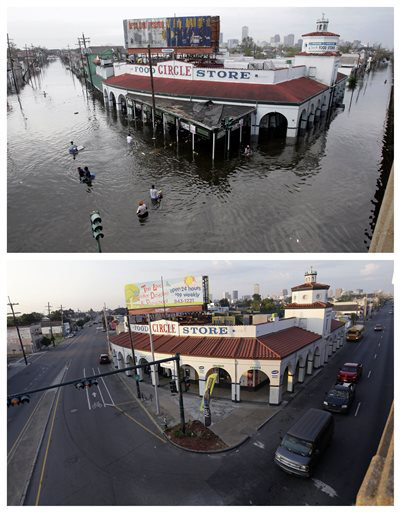
Katrina Then And Now Photo Gallery


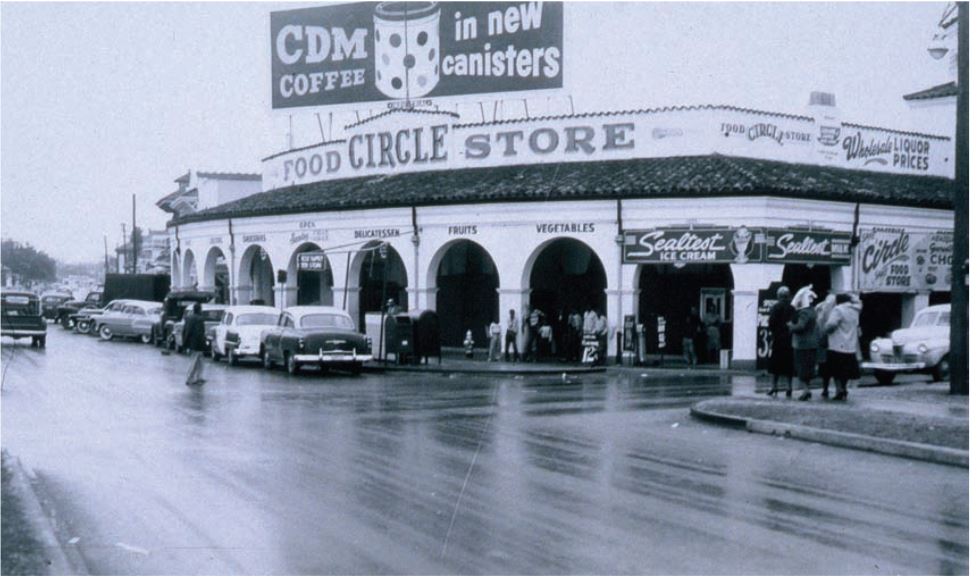
The above  pictures show one location in New Orleans.   I probably don’t even need to explain this or what events the above pictures contrast.  The pictures show the Circle market at normal conditions and the contrasting picture shows it as it looked  during the floods from Katrina or it could be from the 2017 august flood or it could be a prediction for what it may look like with future rain events, or New Orleans future in general.

Since Katrina, there have been tons of studies and projects all focused on sustainable resilient design.  Every one understands the importance of New Orleans culture and community.  So how do we save it? How do we safe this culture?  How do we save one of the great historical cities we have?  The harsh reality is we can only save when we stop destroying it. Beyond things like sea level rise and climate change we have had decades of design and built environments that have done little if anything to cultivate anything but our own appetite for growth.

In my limited time living in New Orleans from Feb 2017 to Sept 2017 I consistently found both frustration and amazement with the city.  I was in awe at how such a place could exist in the face of all we have done to undermine it.  When I look at the flood pictures I cant help but see what is not in the picture anymore.  I can help but see what looks like a river over what would be the river bottom.  This Bottom in this case is the road and or pavement.  Miles and miles of impervious surface.  Hundreds of thousands of square footage’s dedicated to machines not humans not bicycles not trolleys.  I find this to be the elephant in the room when it comes to any discussion of resilient design or architecture for New Orleans.  For the past century cities have been designed not for humans but for the transport of individuals in the name of progress and innovative urban planning.  We  had done more collectively to kill communities through interstates that cut through neighborhoods and 50 mph streets that kill walk ability than we have ever done to create community.

food cirlce market 1950s

circle market map


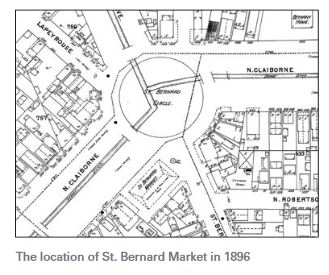
This brings me back to the pictures of the flooded store. The picture above is one of the same location from 1950 and the map below that shows the plans for a market at that location from 1896.  This location as been a one of importance to the community for more than a century and the surrounding community has been there for longer than that.  It is only one example of hundreds spread through out the city.  This one example highlights only one spot that embodies the major issues that plague not only New Orleans but every city. The problem I speak of is design for people and communities that is clearly not designed for communities or people.  I would assume propose that 50-60 100 years ago these driving forces were all pushed in the name of cutting edge innovative design and urban planning centered around the progress of people.  I would argue that in the case for New Orleans past urban planning strategies are just as much responsible for its current and future problems as climate change and hurricanes.  The interesting thing for me is that we can correct our previous design errors.  Hurricanes we cant control , climate change is a slow moving problem that will persist for years to come even if we change our habits immediately.  Mistakes architecture has made is one area that can be immediately addressed.  A great deal of effort is put studies and master plans that dance around the issues but never fully embrace or admit to massive amounts damage done to cities and communities in general by urban designer/master plans put forth in the name of progression and smart growth.  Much like the current master plan assembled by the city at this link

Click to access Resilient_New_Orleans_Strategy.pdf

Of course the study is a well put together document that assembles a ton of data and analysis from experts in all areas.  It addresses not just sustainable design challenges but also economics and business challenges. with sections on a wide range of subjects including things like public transportation and green infrastructure.  In these sections the report talks about increasing efforts and plans to implement things like more bus lines and more rain retention areas.  I find the report speaks in positive terms such as additions and growth which conveys positive themes as do most optimistic views put forth for grand design visions that address issues plaguing a great city.  This is of course where i feel master plans like these always fall short.  They do little to covey proper historical context with little to no explanation of  causation of these problems.  For instance in the section about public transportation i feel it would be beneficial to note that at one point there was approximately  24 different trolley lines servicing the city, presently there are 5 lines.  Another interesting fact is that the implementation of bus lines in the 60s and 70s drove the removal of these trolleys lines until there was only the Saint Charles st line left.   The incorporation of bus lines did two things  firstly they allowed for a more flexible public transit system and secondly they fit into a urban environment that embraced Americas car culture.  In turn we get more vehicles more infrastructure in order to transport a similar amount of people in a city is limited to only 169 square miles, 1/3 of that being wetlands.  So my main issue with master plans and or any greatest design ideologies like resilient design or sustainable design is that they rely on addition and never fully address past mistakes.  They do not speak of undoing past missteps instead choosing to propose additions and retrofits while minimizing alterations to existing infrastructure.

Realistically no amount of rain gardens or bus lines will address the negative effects or early 20th century urban planning or climate change for that matter.  Addressing the influence and impact of elements that stifle community growth and culture will. If  1/3 of New Orleans are wetlands i wonder what percentage of it is paved. I wonder what percentage of it needs to be wetlands in order to address flooding.  I feel that in order for New Orleans, or any coastal city for that matter, to be truly resilient we must focus ideas on adaptation  not addition.  Sometimes progress comes at the cost of regression.

In light of this I am optimistic. For the community and culture have gravitated to this city and the city provides a place that has cultivated a rich and infinitely interesting over community over centuries that survives to this day.  Not due to resilient strategies but because it is resilient. It is resilient in spite of resilient design.

Regression in the name of progress

In September of 2017 i packed everything up and moved to the big ole state of Texas to the Dallas fort worth area for employment.  After a lot of looking I found a place to live pretty close to my work which is located in the historic neighborhood of fairmount.  That will always be of high priority for me.  Previously me and my wife lived in new orleans in the historic bywater neighborhood.  Which happened to be right past the french quarter and only two miles from work.  It just so happens that i live 2 miles from my work here in texas as well.  How ever the the morning trips could not be more different from each other.  Even though fort worth is a larger city then new orleans  and i live within similar proximity to the downtown area the morning commutes pale in comparison.

The amount of architectural richness within my 8 minute drive to work in new Orleans is something that does not exist in Texas.  I think the same amount of architectural density is stretched out over 35 plus miles from Fort worth to Dallas.  Which means its basically nonexistent.  In comparison one feels alienated from experience that is fundamental to being…  well human.

The urban environment( or lack thereof)  is not the only difference.  With the move to a big new city came more opportunity and bigger roads and bigger investments in infrastructure and urban project.  There is daily talks on the news and with people about potential projects to benefit this area like ikea’s and possible amazon headquaters.  Or Hyper-loops connecting both cities along with austin and houston.  It is like the future is here, happening now.

The hyper loop talk is one thing that I peeked my interest when first hearing about it.  The thought of traveling to austin in 19 minutes as opposed to the hours it takes by car seemed like a great solution.  Until i started to think more about what exactly was it a solution to.  The hyper loop addresses the disconnect of cities spread out to much and to far from each other.  So it addresses a symptom  of a problem that we created by a lack of urban density therefore created disconnection.   We are solving the problem of disconnection by some technology that will only perpetuate it.  This is madness

The city of New Orleans covers around 349 square miles while fort worth covers around the same at 350 square miles.  Of that area, New orleans only has around 168 square miles of occupy able land while fort worth has some where around 340 square miles of occupy able land.  The population density of both cities is in between 2,000-3,000 people per square mile.  Which can be a little misleading  since less than half of New Orleans is actually able to have people live on it.  This translates to around double the population on half of the physical land. Possibly Explaining the rich experiential urban fabric as people build a rich dense urban environment.

There was never any talk of hyper loops in New Orleans, one reason was they could never afford it, the other was there was no need for it.

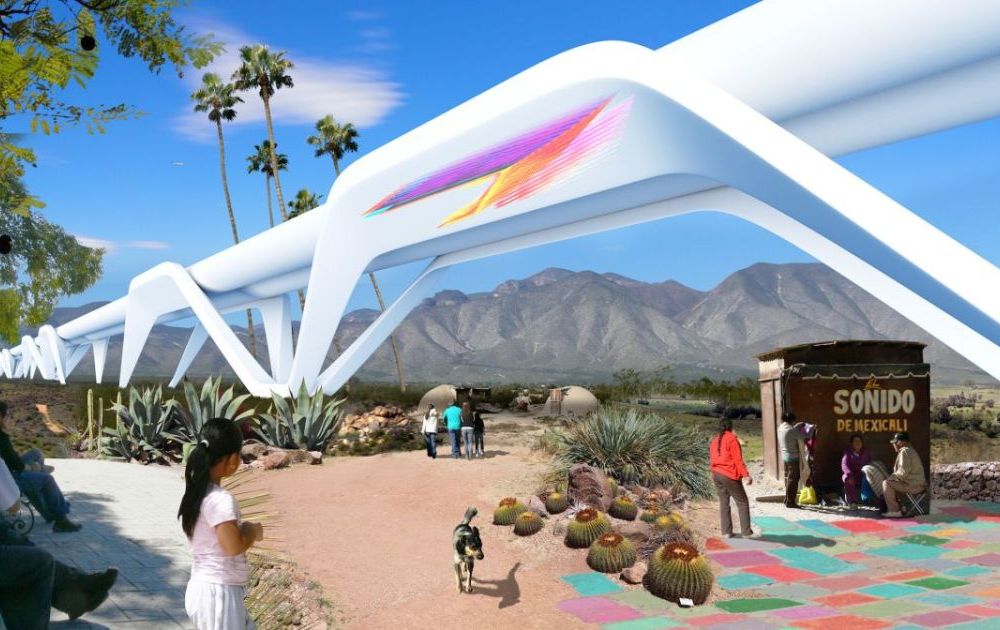
The rendering at the top of this post shows an “idealistic” vision of what a hyper loop could look like and tries to paint a picture of the positive impact it could make.   It does everything right it has people to add a  human scale to it is has a nice picturesque background, it even has animals.  How ever all I see is vast expanse( desert) that in reality would be void of any human activity hence the need for a hyper loop in order to connect the fragmented severely malnourished urban environment.  In fact there is not much that could possibly be more alien and foreign to the human experience than traveling in a dark tube at hundreds of miles an hour.  This used to be the preferred method of transit for bank deposit before we began to go paperless.  I do not know about you but I am not a piece of paper, I want to see things I want to touch and feel the texture of the environment.  I want experience.

I feel It is easy to get caught up in new technology and the excitement of companies like Tesla that I believe genuinely have intentions to solve problems.  It can be especially in a field like architecture as well since we have always pushed for solution and progress as something that will ultimately fix the mess that we find our selves in.  With finite resources being depleted and fractured nonexistent urban environments. One thing we seem to assume is that progress is linear, it however is not.  this is due to our limits with language and the almost identical meanings we have applied to words like progress and forward.  They have come to mean the same thing.

So I feel professions that deal with architecture, urban planning and future professionals in school have to become more analytical of the solutions we offer through our proposals and projects.  We are in a wonderfully optimistic field that accesses the problems of the built environment that involve the building sciences along with the social and economic sciences.  We propose not only solutions but idealistic predictions of how we not only see the world but how we feel it should be.  This requires a certain ability to remove one self from the issue in order to have a unbiased (as possible) take on the issue and form questions that drive solutions.  In some cases the question may be more crucial than a solution  itself.  In fact after all my education in architecture school the most valuable skill i was learned was the ability to ask the right questions.  It far outweighed any computer software I learned or any courses on construction or design.

So why do we need a hyper loop?  Why are our cities so disconnected?  Why do I need to travel to austin in 19 minutes?  Why does the city I live not have what i need which drives me to travel hundreds of miles away?  Why is this better than building better cities?  Why is long distance travel the solution to long distance travel?


Motherhood from a non-mother perspective

It is true, I am not a mother. For many different reasons. I am scared of the pain, of the tears, and also and most of all, I might be afraid of being vulnerable, and not being able to satisfy a child’s needs (good education, adequate food and more), but most of all, I am afraid of being absent, or not being. But what does this mean? I wasn’t entirely sure until yesterday, when I had to go to a kindergarten for a job interview. It was a very beautiful place, clean and friendly. I am walking with the supervisor to see the installations, and she shows me one big room where the most little and delicate babies were (less than one year old). There was a woman in charge that looked extremely sweet and caring, taking care of these babies, probably from 10 to 15 babies in total. The first idea in my mind was…one mother for 10 children, and also, one mother covering 10 other absent mothers. The portrait stuck on my mind for some time. Babies growing up with their parents only at night and on the weekends. Is this adequate? Is this enough to cover a child’s needs? Or is it a society need, where babies have to adapt as soon as they get to this world? It seems that the fact of being a mother, a woman that creates life comes with sacrifices. It was your decision, then you have to adapt to society’s needs and the baby as well.

The fast paced world gets us all dizzy and confused. Mothers have to separate themselves from the fact of being mothers to be able to be recognized as an important member of society. Working and having your kids with you is not allowed. It almost seems like we have the guilt of being able to create life. Since when creating life became a silent crime? I was remembering a terrible intervention from a work colleague (Latin) that told me that working with mothers is the worst experience. they always have problems with their husbands, and the kids are always sick….sometimes men talk as if they were created on the capsules of the matrix, and they don’t come from a mother’s hard and caring work so they could get to the position where they are standing now. We cannot be mothers, we cannot be worried, and at the same time, we cannot feed children in public, breastfeeding is not adequate as well. Oh, I almost forgot, if we are too pretty, we will not be taken seriously, and if we are not that pretty, we must make sure to have a minimum standard of beauty, because women cannot be women without being beautiful. So, perhaps we can think that the most logical thing to do is create some sort of manual of honesty about how to be a woman in this world. It seems a little daunting… so.

During the same day, I was investigating for new job positions that I could apply as well (I am unemployed, and this is why I’m writing today), and I find myself with some ads for the needs of babysitters. One add said something like “I need a babysitter that pick my children from the day care and takes it home and stay with him until 9 pm”….this kid spend more time with strangers than with mom or dad. Motherhood seems to be more qualitative than quantitative….and society forces women to get out of the house to show the world that you can do it equally!!!! Without your baby!!!! Yes you can be like us, the guys!!!! But do not tempt me erotically!!! Or do not bother me with your children’s problems because I do not understand too much about that!!! Anyways…the second add said something like “I need a babysitter that comes to the house from 6 am to 9 am to wake up the kids, get them ready for school and take them to the bus station everyday” so, if this person is not having a disability or an unusual work shift….sounds as a major absence in responsibilities to take care of this children. These perceptions are not made against these mothers; is against the system, where being a mother is almost a disability, and you have to show society that you can be perfectly fine and ok without your kids. Since when life and motherhood became so meaningless? We could almost quote Taylor Swift singing “look what you made me do” in a song that represents the discontent with the situation.

Being able to create life, and being able to take care humanity at his most vulnerable point is a miracle, and it is important, and it does not make mothers useless. We lost that position we had in ancient times, when there were statues created to honor us women as life creators from the tribal point of view. But in this century, that is not necessary anymore. Society needs to find a space and a place for mothers to be mothers without feeling guilty by having the priceless gift of creating life.  Do people and their governments want to reduce abortion rates? Then the concept of motherhood must change from a weakness and negative perspective towards a more caring and valuable attribute of being a woman, a life creator. The most adequate thing is to create some sort of economic relief for mothers from their governments in the first years of life to increase that lost connection between mother-child, that is vital and important, and that powerful and successful individuals in society cannot perceive, because they were born in capsules created by a matrix, and they did not came from their own mothers. Sorry that it was a little bit of a rough material, but it is what I have so far.

The fiction in meaning

Every year or so, me and my wife will have a history scholar come and stay with us for a month or two.  When they come to visit from their home in Venezuela. I have the opportunity to have an additional person to have interesting conversation with.  Often times these  conversations leave me barely treading water for not only am I having a conversation with a former university professor,  but also a person who worked in historical preservation of architecture.  So they are well versed in multiple subjects with a deep philosophical understanding as well.  Ive been accused of being a grumpy cat so I happen to really enjoy challenging discussion about history and architecture’s sociological implications.  The more challenging provocative/cynical the better for me.

Often times conversations between would start on a seemingly simple mundane topic.  As we would progress the conversation would eventually get to a point were I was either deeply questioning some thoughts or opinions I have withing myself or the topics allowed my to stumble onto new thoughts.  Sometimes these ideas may not fully manifest until later.  Much like these thoughts I am typing about right now are based on a conversation from almost a year ago.

It was during the spring of 2016 towards the end of my 2nd semester as a graduate student.  I was deep in the middle of course that prepared us for my coming thesis project.  So I was trying to find out what my ideals about architecture were, and I was trying to decipher or translate my frustrations with it.  I felt there was a severe disconnect between architects/designers and “architecture”. From my perspective there is a real detachment, or self imposed divorce from the intrinsic nature or experience  From all the theory that we have to read to some of my professors themselves;  I picked up, what felt like to me was a deep desire to justify architecture objectively.  Almost as if Victor Hugo was both the reaction and a causation when he wrote that the printing press had killed architecture in the early 1800’s.   I mean how could one not feel threatened by a statement like that or be forced to react.  Justifiably  modernism attempted to address these insecurities by resisting ornamentation and embracing function.  This was causing me to experience a sort of existential crisis within my own little world of architecture.

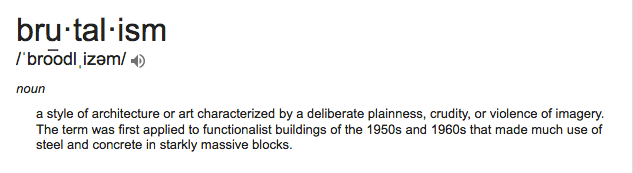
Well like I stated before the conversations between myself and the visiting professor that day began with discussion about the futurist architecture movements and then onto the types of architecture in Latin America compared to the west.  Eventually we began talking about the use of concrete and its implementation.  I believe i may have made a comment/comparison to brutalism when discussing a piece of architecture or style she liked.  Well the conversation began to take on the ton of a debate as she took offense.  I did not quite understand as i kept on describing the architecture as brutalist in nature.  Eventually my wife came into the conversation.  The professor’s main language is obviously Spanish , and she understands English but only speaks a little of it, Which is more than i can say because i am still after being married for 3 years and my Spanish is muy poquito.  So it was not until my wife joined the conversation and spoke to her in Spanish that I learned that brute in Spanish has a more derogatory meaning and that they did not refer to that style of architecture as that.  She also took offense because she enjoyed this type of architecture and appreciated its historical significance.

This was the moment in the conversation were almost immediately mythoughts or notions about a subject were washed away and challenged.  Here I was having a conversation with someone about a subject that was derailed by one word.  Or more importantly the meaning.  I, like most took the meaning as universal fact.  I was knowingly talking to someone in there second language yet for about 15 minutes I did not even think about the meaning of words I was using.  For the sake of time and efficiency, I summarized a whole typology of architecture with one word.  The meaning for me being true in the face of its fiction to another.

I never really looked at words like that quite before.  Especially now that I am looking back at this conversation.  Its as if words and meaning embody contradictory characteristics.   I am both amazed at their ability to convey and confuse.  In a way I am attracted to this idea.   They both enable us while simultaneously being responsible for our inability.


P.s

The Visiting historian is my wife’s mother (my mother in law).