(Spoiler Alert)

The Joker is the new famous movie about a failed comedian named Arthur Fleck that works in a clown company at Gotham city that gave Joaquin Phoenix an oscar for best actor in 2020. The story might sound simple, but it is a very complex and intrincate film that mixes psycho-dynamic and sociological elements by exposing the drama of failed mental health services inside of an anemic society that reflects the fragility of the human psyche.
When we take a look at how the society is portrayed on the film, it seems that there is not too much of a difference between Gotham city and the United States. This is evidenced on the deep gap between lower and upper socioeconomic classes that is reflected closely when showing the hypothetical relationship between the Joker (the poor) and his “father” (the rich and powerful father of Bruce Wayne). The Joker’s mother also suffer from deep mental diagnoses, but this is something that he is not aware of as a son. The movie also shows how the Joker’s mother was neglecting his son due to her psychiatric conditions and allowed him to be exposed to violence at home as well. Johnson et al. (1999) demonstrated that childhood neglect and physical abuse (But not sexual abuse) predicted an increased prevalence of adult antisocial symptoms. The mother makes his son believe that he is the son of this rich character (Thomas Wayne), when this is not true.
It seems that the breaking point for the Joker is the moment when he realizes that he is not his father’s son, and his mother is also not his mother; he was an orphan. This takes the Joker to kill his mother, using a narcissistic resource to kill the reality that he doesn’t want to experience, which can be understood as a psychotic element. Here we can find evidence how there is no space for grief or any pause for reflection of this painful discovery, showing that killing is the only way to suppress what it is not wanted. This is a reflection of the extreme pathological elements of an antisocial disorder and narcissistic personality disorder. The narcissistic elements seem to be mixed with psychotic elements that are evidenced when the Joker loves to act as if he is famous and loved in recurrent fanstasies, showing a superiority complex based on psychotic grandiose delusions. This is also showed at the story when he creates a delusional and non existing relationship with his neighbor. Lets go back to the relationship between the joker and the anomia experienced on Gotham City.
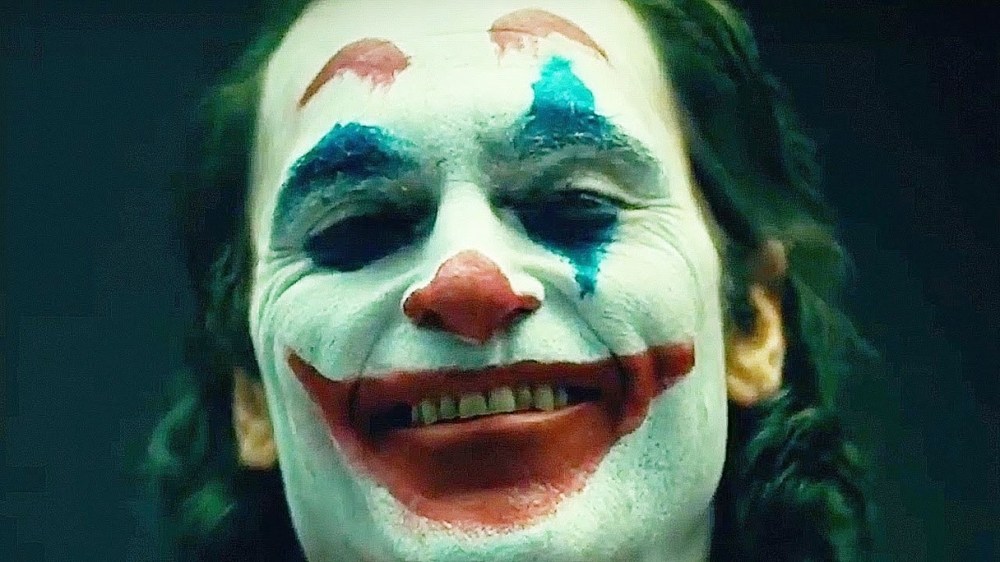
The moment that the Joker kills the show host (Robert DeNiro) on live television is when a revolution begins on the streets of Gotham City. People goes out to the streets to vandalize, destroy and kill wearing clown masks, almost like reflecting the logo or symbol that represents the revolution of the lower socioeconomic class against the higher up class in power. The individual becomes an unidentified clown, a clown that nobody cares who is angry, a complete explosion of “ID” from the psychodinamic point of view. It is interesting to observe that at the moment that individuals wear a mask in front of others, they are hiding themselves of who they truly are, which makes them free to really be themselves.
This is one of the most poetic contradictions of the film. When society takes the joker as “God”, the antisocial traits of this character are validated, and the main symptoms of the antisocial personality disorder of this leader are translated into an anomic revolution. This seems to be a reflection of the different historical revolutionary process that occurs when antisocial leaders guide society towards a desctructive pattern of death and destruction of human rights.
This film also reflects how the elites deny and suppress the suffering of the proletariat, as well as the despise for mentally ill individuals. The joker seems to represent the dark side of society as a new archetype of the poor, the ill and psychotic individual that attains power by killing and destroying anything that doesn’t reflect what it is desired to experience. There is one scene where the elites are attending to the movie theatre for the premiere of the movie modern times of Chaplin. It is widely known that this great film depicts the drama of the industrial revolution and its effects on the human psyche in the shape of a comedy. sadly, this is one of the few accepted ways to show publicly the disparities between the working class and the elites, something that it seems to be attempted as well with the Joker.

All the audience laughs at the movie (it is expected, it is a comedy), laughs at the poor and the oppressed because it has been sublimed through art, an acceptable way to approach to the suffering of poverty. The previously described is also reflected on the forced smile of the joker. We must laugh of our own suffering, even when we want to cry, something that is commonly found on modern self-help psychology, forcing the individual to have an optimistic point of view of their own suffering that is partly caused by societal constraints that are almost impossible to modify.The happy clownish mask of the joker serves as a negotiation between the wild needs of the id (unconscious entity of the psyche that deals with instinctive desires) and the struggles of the punitive superego (conscious entity that entails morality and introjected social norms).
Therefore, the mask becomes the Ego (the mediator between the “ID” and the superego), the middle ground that deals with the clash between the antisocial drive and social norms. The expression of forced laugh can also be seen as a manic coping mechanism against depression. It is almost as if time as a variable disappears from a bipolar disorder and mania and depression occurs at the present moment. Meloy (1988) argues that another aspect of superego pathology more characteristic of the true psychopath than of the higher level narcissistic variants is a complete lack of effort to morally justify or rationalize the antisocial behavior, something that is evidenced on the different murderers perpetrated by the Joker. He actually feels euphoric and full of energy after killing without even rationalizing about the nature of the event.
The film also exposes how mental health services are not a priority in society. The despise for mental illness is evidenced on the extreme antisocial and narcissistic personality disorder of the Joker, which represents the darkest and unpredictable side of the human psyche that needs to be contained and hidden. Glenn Gabbard argues that antisocial patients are perhaps the most extensively studied of all those with personality disorders, but they are also the patients whom clinicians tend to avoid the most. The most clear scene of this matter on the film is when the Joker meets with his social worker and she informs him that he wont be able to get anymore services (including psychiatric medications) because they are shutting down the health services. The Joker replies to this with “They just don’t care about me” to what the Social worker replies “They don’t care about me either”, another sad reflection from the actual mental health situation that the United States is facing.
 againstindifference.com
This is very interesting. I think it’s important to note that while he does develop antisocial traits as the movie progresses, he doesn’t start out with these.
The character is repeatedly traumatized and victimized throughout the movie, and offered no compassion and no support.
I would say that his dissociative reactions are symptoms of the trauma he experienced, beginning in childhood. This would also explain why he does not remember his childhood.
The breaking point is when he realizes that the only thing that gave him any dignity was a lie, and the person who offered any shelter love was the perpetrator of this lie, and an accomplice in his abuse. His identity is shattered and that moment, and that’s when the tormented Arthur Fleck is replaced with the joker.
LikeLike
Thank you so much for your perspective and insights about the article
LikeLike
Thank you so much for your perspective and insights about the article
LikeLike